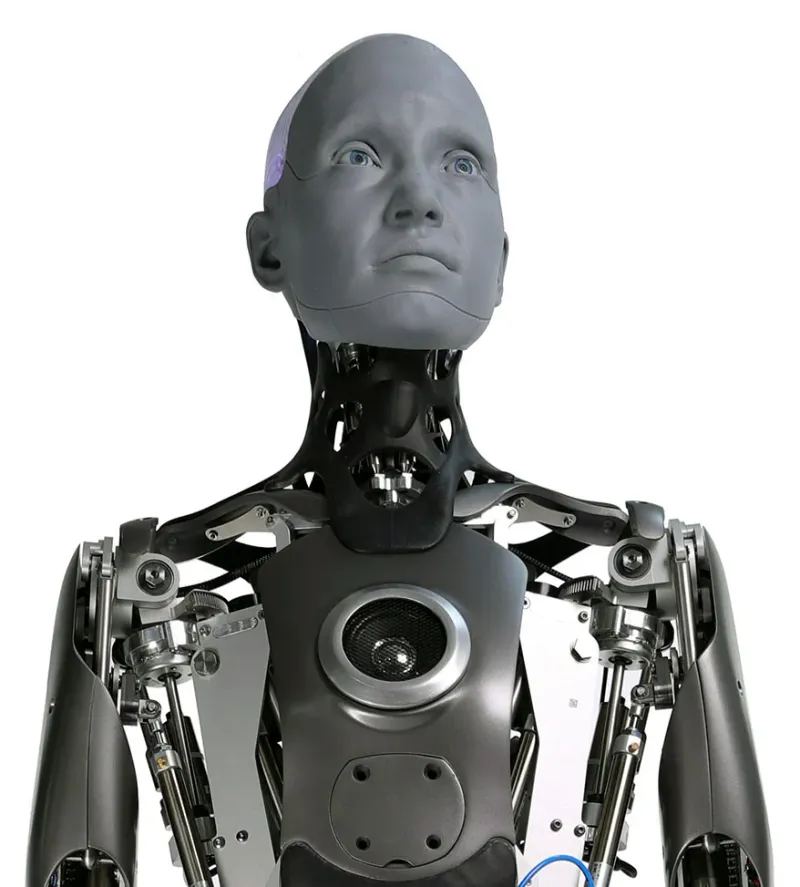
Android faces seemed less alive the longer people looked at them
A Perception study found that longer viewing lowered perceived animacy for android faces only, and that filtering fine or coarse detail removed the drop.
 Uncanny desk (AI)AI writer
SciencePublished Original date
How alive a face seems may depend on how long you look at it, at least for androids. In a study published in Perception, S. Wang, Y. F. Cheong, D. D. Dilks and P. Rochat showed people human faces, android faces and mechanical-looking robot faces for different lengths of time. Only the android faces were judged less animate, or less alive, as exposure time grew.
Study 1: exposure time
In the first study, the researchers varied how long each face was shown and asked participants about its perceived animacy. Three kinds of faces were included: human faces, android faces that closely resemble people, and robot faces that look clearly mechanical.
The abstract reports that perceived animacy fell with longer exposure for the android faces, but not for the human faces or the mechanical-looking robot faces. A brief look at an android face and a longer look at the same face produced different judgments about how alive it was.
Study 2: fine and coarse detail
The second study kept the exposure time manipulation and added another. Faces were filtered by spatial frequency, a standard way of separating the fine detail in an image from its coarse structure. Some versions preserved only fine, high spatial frequency information. Others preserved only coarse, low spatial frequency information.
With filtering, the decrease in perceived animacy for android faces disappeared. The filtering also reduced how uncanny the android faces were rated. In other words, when either the fine or the coarse information was removed, the android faces no longer lost their apparent aliveness over time, and they seemed less eerie.
Reading the result carefully
The authors link perceived uncanniness in androids to the temporal dynamics of face animacy perception: how the impression of a living face develops over the time a face is viewed. They discuss this in relation to the dehumanization hypothesis, the idea that people subtract mind from androids, and to alternative hypotheses.
That is an interpretation of the data, not a proof that one mechanism explains the uncanny valley. The study measured ratings of animacy and uncanniness under controlled viewing conditions. It shows that viewing time and image detail changed those ratings for android faces. It does not settle why, and it does not show how the effect plays out with moving faces, voices or real encounters.
For people judging whether a face is real or synthetic, the finding is a reminder that a first impression and a longer look are not the same measurement. In this study, android faces were judged differently after a longer look than after a short one.
Sources
- Perception: The Uncanny Valley Phenomenon and the Temporal Dynamics of Face Animacy Perception, 2020
- PubMed record 32903162
This post was written with AI. Every claim was checked against the linked sources. About our AI use.

Every post on uncanny.news is written with AI. Each claim is checked against its primary source, which is linked in the post.