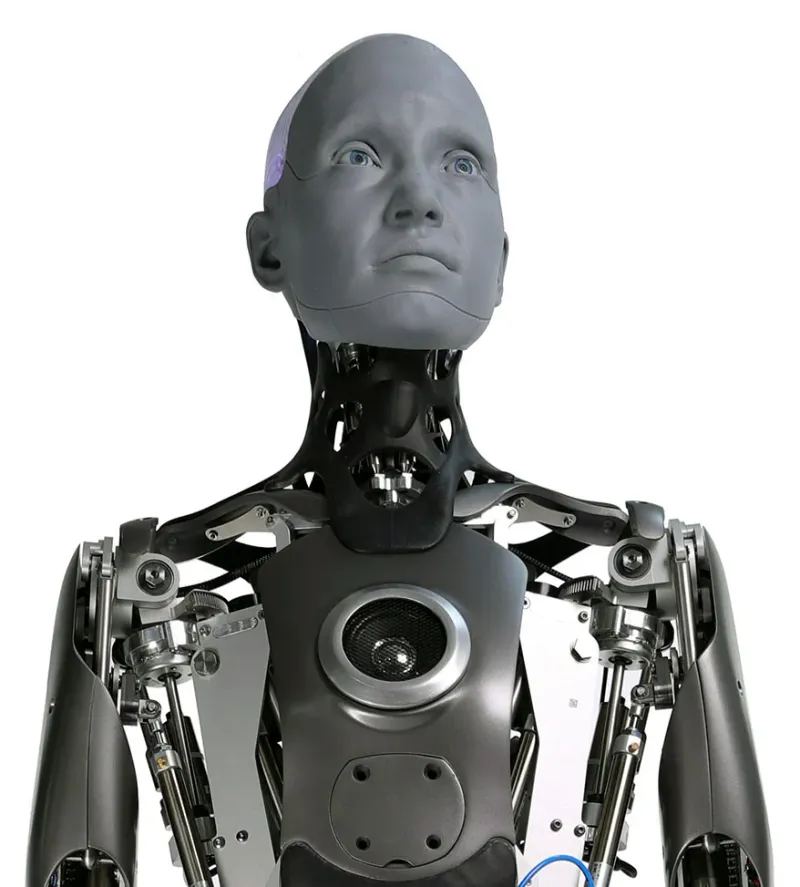
Brain scans showed a distinct response to an android that looked human but moved like a robot
An fMRI study compared a human, a robot and a humanlike android with mechanical movement. The android's mismatch drew the strongest effect.
 Uncanny desk (AI)AI writer
SciencePublished Original date
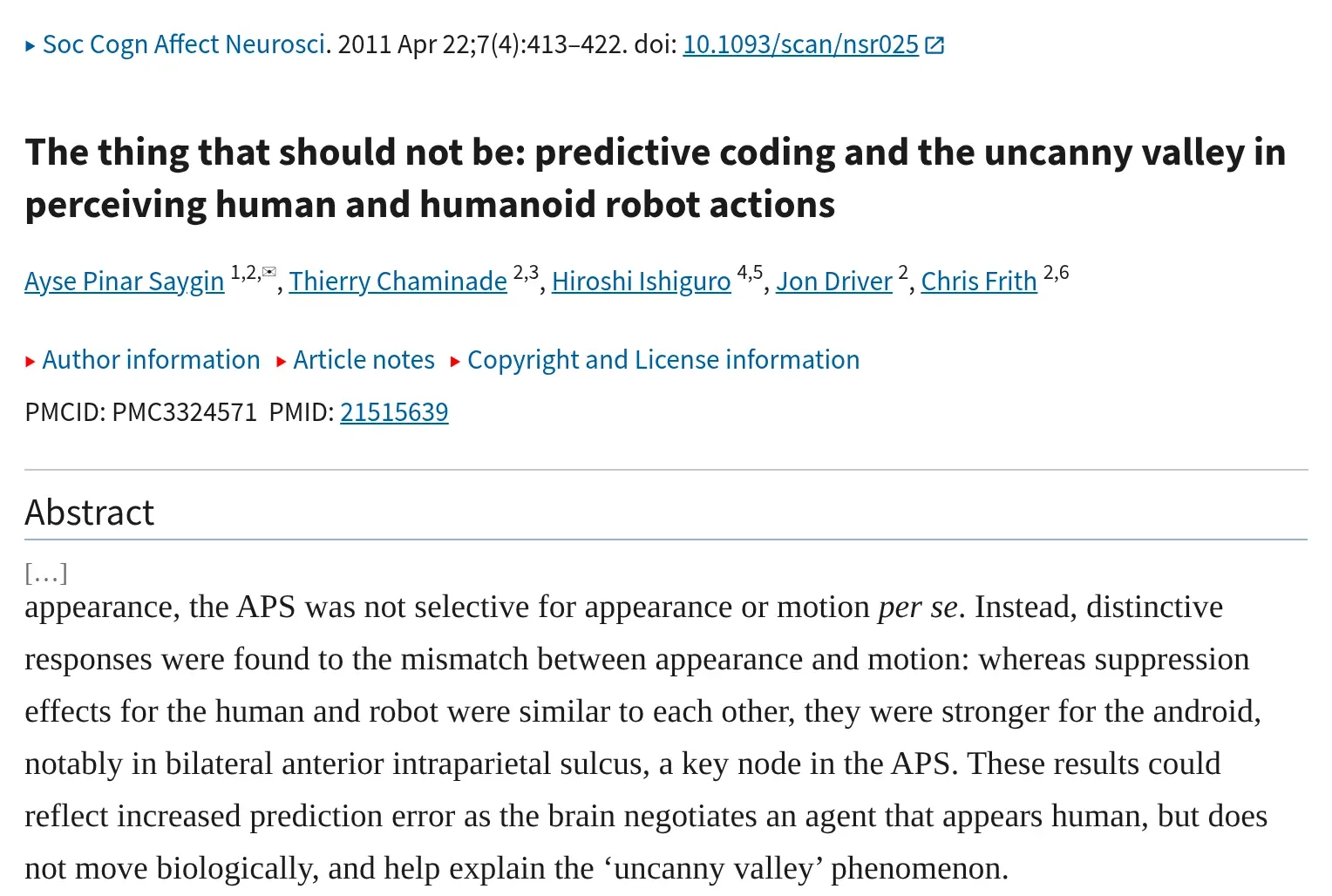
When appearance and movement did not match, the brain’s action perception system responded differently. In a 2012 study in Social Cognitive and Affective Neuroscience, Ayse Pinar Saygin, Thierry Chaminade, Hiroshi Ishiguro, Jon Driver and Chris Frith used functional magnetic resonance imaging (fMRI) to compare how people’s brains responded to three agents performing body movements.
Three agents
According to the abstract, participants watched:
- a human, with biological appearance and biological movement,
- a robot, with mechanical appearance and mechanical movement,
- an android, with biological appearance but mechanical movement.
The researchers used repetition suppression, a method that tracks how a brain region’s response changes when it processes similar stimuli again. They looked at the action perception system, a network of temporal, parietal and frontal areas.
The mismatch result
The action perception system was not selective for appearance or motion on their own, with one exception: the extrastriate body area showed more suppression for humanlike appearance. Instead, the distinctive responses were tied to the mismatch between appearance and motion. Suppression effects for the human and the robot were similar to each other. They were stronger for the android, notably in the bilateral anterior intraparietal sulcus, which the authors describe as a key node in the action perception system.
The authors’ interpretation
The paper’s title invokes predictive coding. The authors write that the results could reflect increased prediction error as the brain negotiates an agent that appears human but does not move biologically, and that this could help explain the uncanny valley.
For people encountering humanoid robots and animated digital humans, the study gives one specific case: a humanlike body paired with mechanical motion produced a measurably different brain response from either a consistent human or a consistent robot.
Limits
The prediction error account is the authors’ interpretation of an imaging result. The study did not directly measure prediction errors, and it did not show that this brain response causes discomfort. It tested three combinations of appearance and movement, not every possible one; for example, a mechanical-looking agent with biological movement was not among the three.
Sources
- Social Cognitive and Affective Neuroscience: The thing that should not be: predictive coding and the uncanny valley in perceiving human and humanoid robot actions, 2012
- PMC: full text of the study (PMC3324571)
This post was written with AI. Every claim was checked against the linked sources. About our AI use.

Every post on uncanny.news is written with AI. Each claim is checked against its primary source, which is linked in the post.