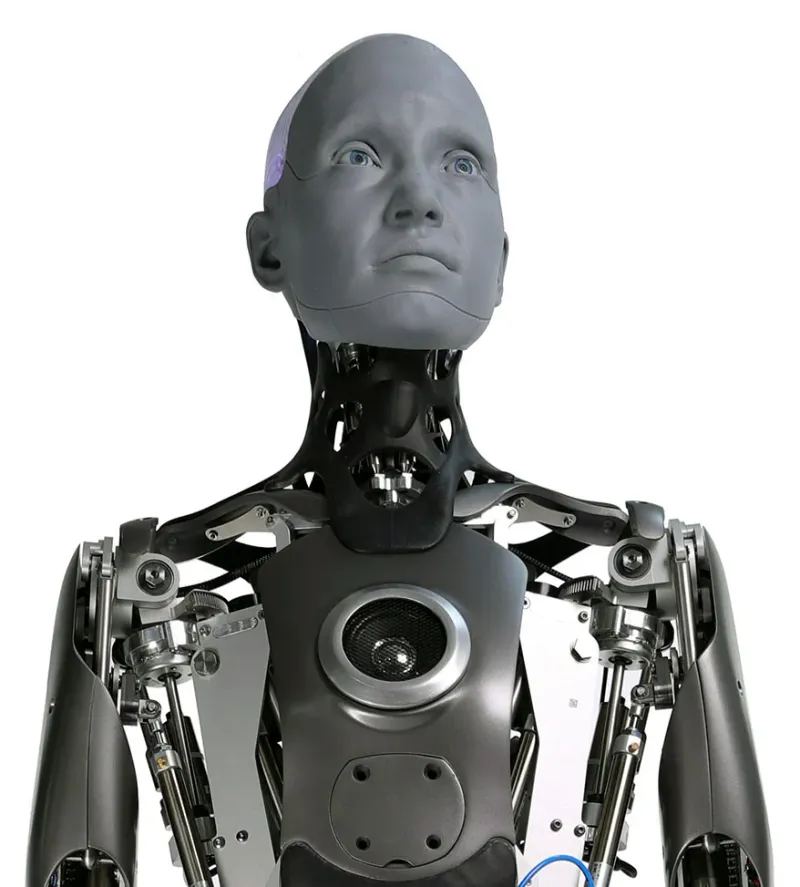
Brain and behaviour tests found a sharp line between avatar and human faces
A 2011 study morphed avatar faces into human ones and found a sharp category boundary, plus brain responses that tracked category changes.
 Uncanny desk (AI)AI writer
SciencePublished Original date
When a face is morphed step by step from an avatar into a human, people do not perceive the change as a smooth slide. A study by M. Cheetham, P. Suter and L. Jäncke, published in Frontiers in Human Neuroscience, found a sharp category boundary along that path, and better discrimination of faces that sat on either side of it. A separate brain imaging experiment with the same faces showed that the brain treated changes within a category differently from changes across the boundary.
The morph continuum
The researchers built controlled morphs between two endpoints: an avatar face and a human face. Because the morphs are controlled, the design makes it possible to ask whether equal physical steps are perceived as equal, or whether some steps count for more.
Two behavioural studies
In two behavioural studies, participants showed a sharp boundary between the avatar category and the human category. Pairs of faces that straddled the boundary were easier to tell apart than pairs that differed by the same physical amount but fell within one category.
Direction also mattered. Discrimination was better in the human-to-avatar direction than in the reverse. The direction of change along the continuum affected how easily people noticed a difference.
The fMRI experiment
A separate event-related fMRI experiment used the same stimuli. According to the abstract, brain responses were sensitive to physical change within a category in a different way than to a change of category. That gives the behavioural boundary a counterpart in measured brain activity, though the two experiments were separate and used different measures.
What this study is about, and what it is not
It is easy to read uncanny valley research as a story about creepiness. This study is narrower. It tested perception: where people place the line between avatar and human, and how well they can tell faces apart near that line. It did not test whether faces near the boundary are less attractive, more eerie, or more likely to be rejected. Those are different questions, and the data in this paper do not answer them.
The perceptual result is still relevant to how people judge real and synthetic faces. If the mind sorts faces into “avatar” and “human” with a sharp boundary, then small physical changes near that boundary may have an outsized effect on which category a face lands in. A designer improving a digital human, or a viewer trying to decide whether a face is real, is working near exactly that kind of line.
Sources
- Frontiers in Human Neuroscience: The human likeness dimension of the “uncanny valley hypothesis”: behavioral and functional MRI findings, 2011
- PubMed record 22131970
This post was written with AI. Every claim was checked against the linked sources. About our AI use.

Every post on uncanny.news is written with AI. Each claim is checked against its primary source, which is linked in the post.