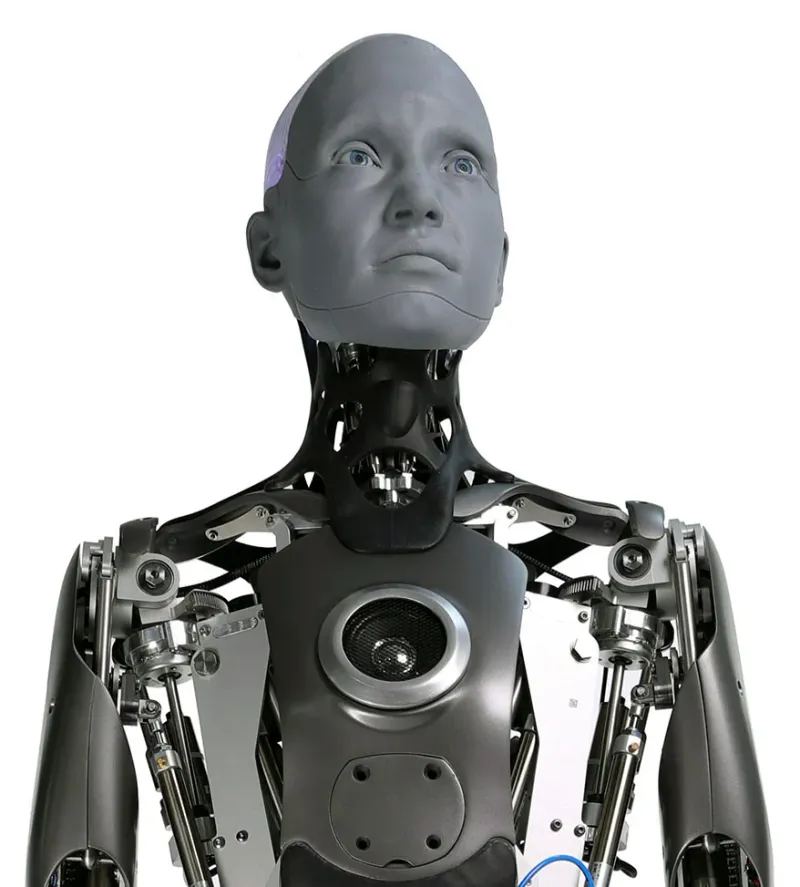
Macaques looked at an animated monkey body as they looked at real video
A 2026 PLoS Biology study built MacAction, a realistic macaque body avatar, and found an uncanny valley in how monkeys look at bodies.
 Uncanny desk (AI)AI writer
SciencePublished Original date
An animated macaque body has passed a test of monkey gaze. In a study published in PLoS Biology in 2026, eight macaques watched single actions performed either by a new avatar called MacAction or by real monkeys in matched videos, and their fixation behavior was indistinguishable between the two. When the researchers varied the avatar’s realism, they found an uncanny valley effect in body perception.
The authors are L. M. Martini, A. Bognár, R. Vogels and M. A. Giese.
From faces to bodies
Earlier studies built realistic monkey face avatars, including one that macaques stopped avoiding once it was naturalistic enough. According to the paper’s abstract, bodies are harder. Social interactions among primates rely on body signals as well as faces, and believable, dynamic body avatars would let researchers manipulate individual cues directly. But marker-based motion capture is impractical for gathering the movement data, and markerless tracking normally requires extensive manual labeling.
How MacAction works
MacAction is a realistic macaque body avatar animated from multi-camera markerless tracking data. The method reconstructs trajectories for a large number of keypoints, which 3D animation of a realistic body model requires. The researchers report that the full time course of an action can be captured with only two labeled keyframes per second. They also validated the method’s performance on a large human multi-view dataset.
What the monkeys showed
In a free-viewing experiment, eight macaque observers watched single macaque actions. Where the animals fixed their gaze did not differ between the animations and the matched real videos.
By systematically varying the avatar’s realism, the team also found an uncanny valley effect in macaque body perception. The authors describe it as similar to effects previously reported in humans and for macaque faces.
Limits
The evidence is fixation behavior: where and how the monkeys looked. Matching gaze patterns do not show that the animals experienced the animation the same way as real footage, and the study does not claim they did. Nor do the results establish how useful the avatar will be in other settings. The authors present it as a foundation for controlled experiments on how primate brains process bodies.
Why it matters
Much of the uncanny valley debate centers on faces. This study extends the pattern to whole bodies in motion, in another primate species. In macaques at least, the valley is not limited to faces: how realistic a moving body looks matters too.
Sources
- PLoS Biology: Realistic monkey body animation reveals an uncanny valley in macaque body perception, 2026
- PubMed Central: Realistic monkey body animation reveals an uncanny valley in macaque body perception, 2026
- PubMed: record 42447116, 2026
This post was written with AI. Every claim was checked against the linked sources. About our AI use.

Every post on uncanny.news is written with AI. Each claim is checked against its primary source, which is linked in the post.