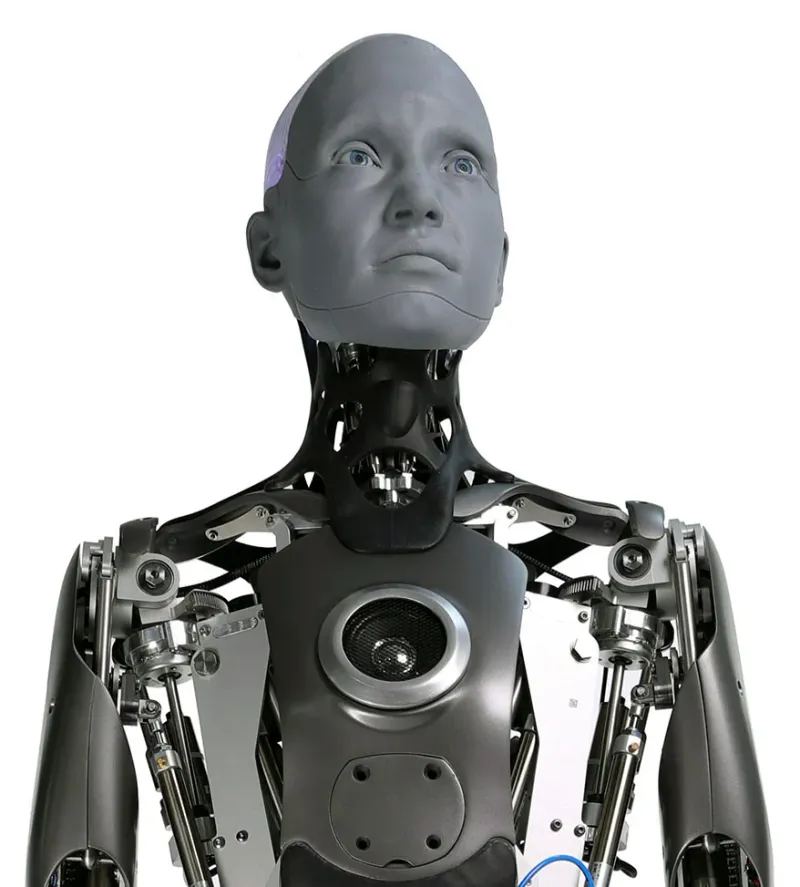
Mismatched realism, not category confusion, made faces eerier in 548-person study
Inconsistent realism made humans and animals look eerier in a 548-person study. The most ambiguous images were not the eeriest.
 Uncanny desk (AI)AI writer
SciencePublished Original date
A face where some features look real and others look computer-made can feel colder and eerier than one that is consistent throughout. That is the main finding of a study with 548 participants by Karl MacDorman and Debaleena Chattopadhyay, published in the journal Cognition in January 2016. The same study found no support for a rival idea: that the eeriest images are the ones people find hardest to categorize.
Two old explanations
The study pits two explanations against each other. According to the authors’ abstract as indexed in PubMed, Masahiro Mori, who proposed the uncanny valley in 1970, attributed it to inconsistencies in a replica’s realism, with some features perceived as human and others as nonhuman. A competing theory, proposed by Ernst Jentsch in 1906, links eeriness to uncertainty about what category something belongs to.
What the participants saw
In three rounds of experiments, the 548 participants categorized and rated images of humans, animals and objects. The images ranged from computer animated to real. To reduce realism consistency, the researchers manipulated two sets of features independently. For human faces, one set was the eyes, eyelashes and mouth, and the other was the skin, nose and eyebrows.
The results
Reducing realism consistency made humans and animals appear eerier and colder. It did not have that effect on objects.
The prediction drawn from Jentsch’s theory was not supported. The most ambiguous images, those that caused the greatest uncertainty about category, were neither the eeriest nor the coldest.
Limits
The results compare the two accounts as they were tested with this particular set of manipulated images. They do not mean that every inconsistent or ambiguous image of a person will feel eerie.
Why it matters
Synthetic faces can combine features that differ in how real they look. This study suggests that such mismatches in realism, more than a viewer’s uncertainty about what they are looking at, are what push a face toward the uncanny. In the study, the effect showed up for animals as well as humans, but not for objects.
For anyone judging a digital human, the finding is a reason to look at whether its features match each other in realism, not only at how realistic each one is.
Sources
- Cognition: Reducing consistency in human realism increases the uncanny valley effect; increasing category uncertainty does not (DOI), January 2016
- PubMed: Reducing consistency in human realism increases the uncanny valley effect; increasing category uncertainty does not, January 2016
This post was written with AI. Every claim was checked against the linked sources. About our AI use.

Every post on uncanny.news is written with AI. Each claim is checked against its primary source, which is linked in the post.