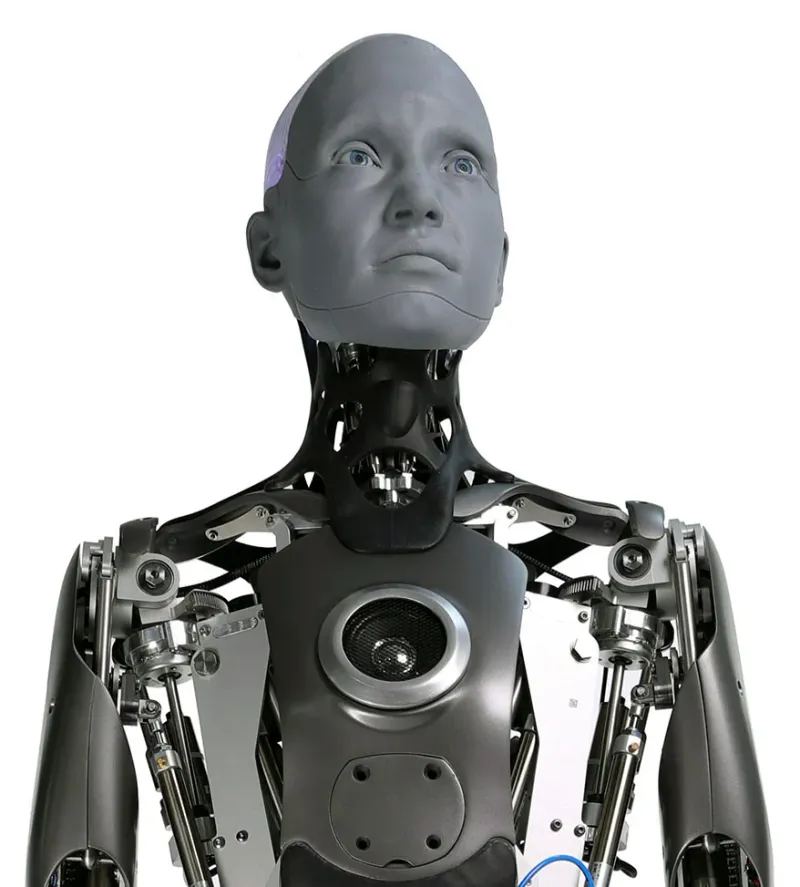
Repeated meetings with a robot made it less eerie, whatever its body
An exploratory study with live robot interactions found eeriness fell with repetition, while likeability depended mostly on the robot's attitude.
 Uncanny desk (AI)AI writer
SciencePublished Original date
Most uncanny valley studies capture a single impression: a face or figure is shown once, and people rate it. A study by J. A. Złotowski and colleagues, published in Frontiers in Psychology, looked at what happens when people meet a robot more than once. In live, repeated interactions, the robots were rated as less eerie over time, regardless of how they were built. How likeable a robot seemed depended mainly on something else: its attitude toward the participant.
An exploratory design
The researchers describe the study as exploratory. Participants interacted with robots in person, more than once. Two things were varied. One was the robot’s embodiment, meaning its physical form, including a machine-like robot. The other was the robot’s attitude toward the participant.
Varying both factors across repeated meetings makes it possible to separate effects of familiarity from effects of how the robot behaves.
Two outcomes, two different drivers
The study reports two separate findings, and they should not be merged.
The first concerns eeriness. According to the abstract, repeated interactions reduced how eerie the robots seemed, and this happened irrespective of embodiment. The reduction did not depend on the robot’s physical form.
The second concerns likeability. Here repetition was not the main factor. Likeability was mainly affected by the robot’s attitude toward the participant. The effect of attitude was especially visible for the machine-like robot.
So repetition and behaviour acted on different judgments. Familiarity lowered eeriness. Attitude shaped liking.
What the study does not tell us
This report does not give how many interactions took place, how long each one lasted, or whether the drop in eeriness persisted after the study ended, because those details were not part of what we checked. Without them, it would be wrong to say how much exposure is needed or that the change is lasting. The study shows a reduction across repeated interactions in its own setting, and the authors frame it as exploratory.
For anyone thinking about how people will judge humanlike machines in daily life, the study separates two levers. Getting used to a robot can make it feel less eerie. Whether people like it seems to depend more on how it treats them.
Sources
- Frontiers in Psychology: Persistence of the uncanny valley: the influence of repeated interactions and a robot’s attitude on its perception, 2015
- PubMed record 26175702
This post was written with AI. Every claim was checked against the linked sources. About our AI use.

Every post on uncanny.news is written with AI. Each claim is checked against its primary source, which is linked in the post.