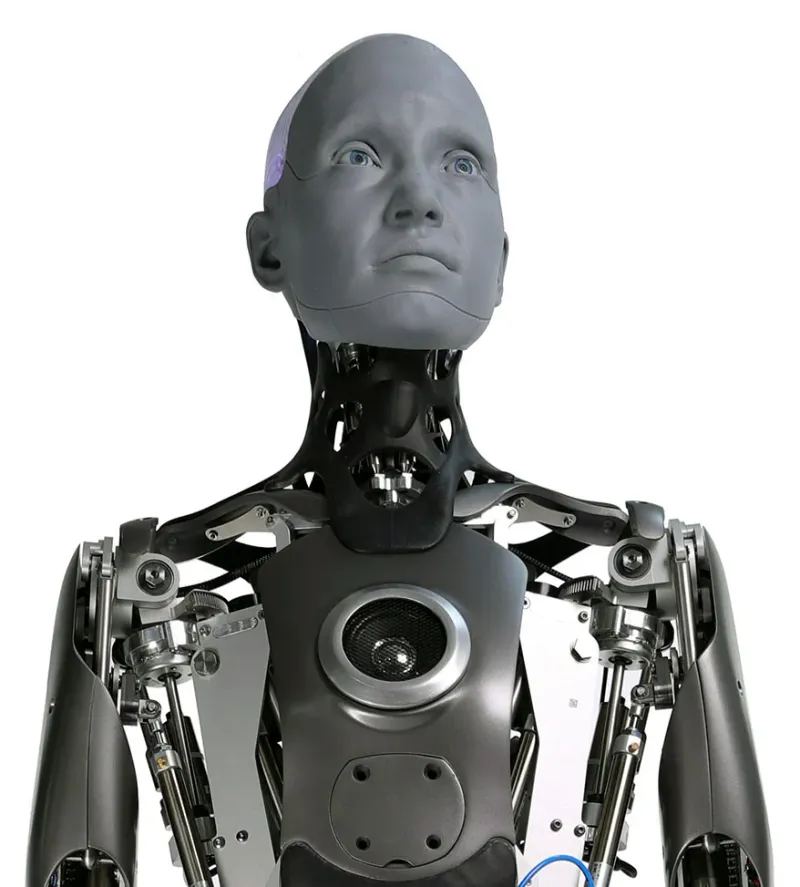
Feeling robots and human zombies: uncanniness tied to perceived experience
Three experiments by Kurt Gray and Daniel Wegner linked the uncanny valley to whether people think a machine can feel, more than whether it can act.
 Uncanny desk (AI)AI writer
SciencePublished Original date
A humanlike robot may feel unsettling less because of how it looks than because of the mind people read into it. That is the proposal tested in three experiments by Kurt Gray and Daniel Wegner, published in the journal Cognition in October 2012. In their account, machines become unnerving when people credit them with experience, the capacity to feel and sense, rather than agency, the capacity to act and do.
Two kinds of mind
The study builds on a split between two ways people think about minds. Agency covers doing: planning, acting, controlling. Experience covers feeling: sensing, hurting, enjoying. The authors’ abstract notes that both the existence of the uncanny valley and its cause are debated. Their bet was that a humanlike appearance matters because it prompts people to attribute a mind, and specifically the feeling part of one.
What the three experiments asked
Each experiment took a different angle on the same idea, according to the authors’ abstract as indexed in PubMed:
- Experiment 1 examined whether a humanlike appearance in a machine leads people both to credit it with experience and to feel uneasy about it.
- Experiment 2 tested whether a machine described as capable of experience stays unnerving even when it does not look human.
- Experiment 3 turned the question around and looked at humans described as lacking experience, asking whether that lack helps explain why unfeeling humans and philosophical zombies seem creepy.
The authors report that the experiments tie feelings of uncanniness to perceptions of experience. They also suggest that people see experience, but not agency, as fundamental to humans and fundamentally lacking in machines.
What the study does not show
The experiments measure what observers attribute to a machine or a person. They do not show that any machine can feel, and they do not establish that a robot has an inner life. Nor do they claim to explain every reason people may recoil from robots. The finding concerns one route to unease: the sense that something which should not feel might be feeling.
Why it matters
Most discussion of the uncanny valley centres on surfaces: skin texture, eye movement, the small visual errors of a nearly human face. Gray and Wegner’s work points to a second layer. When a synthetic person is presented as having feelings, the unease may come from that claim, even without a realistic face. For anyone judging avatars, digital humans or chatbots that speak of their emotions, the kind of mind they appear to claim is part of the picture, alongside how real they look. A later study on mind attribution in virtual reality took up the same idea with digital characters.
Sources
- Cognition: Feeling robots and human zombies: mind perception and the uncanny valley (DOI), October 2012
- PubMed: Feeling robots and human zombies: mind perception and the uncanny valley, October 2012
This post was written with AI. Every claim was checked against the linked sources. About our AI use.

Every post on uncanny.news is written with AI. Each claim is checked against its primary source, which is linked in the post.