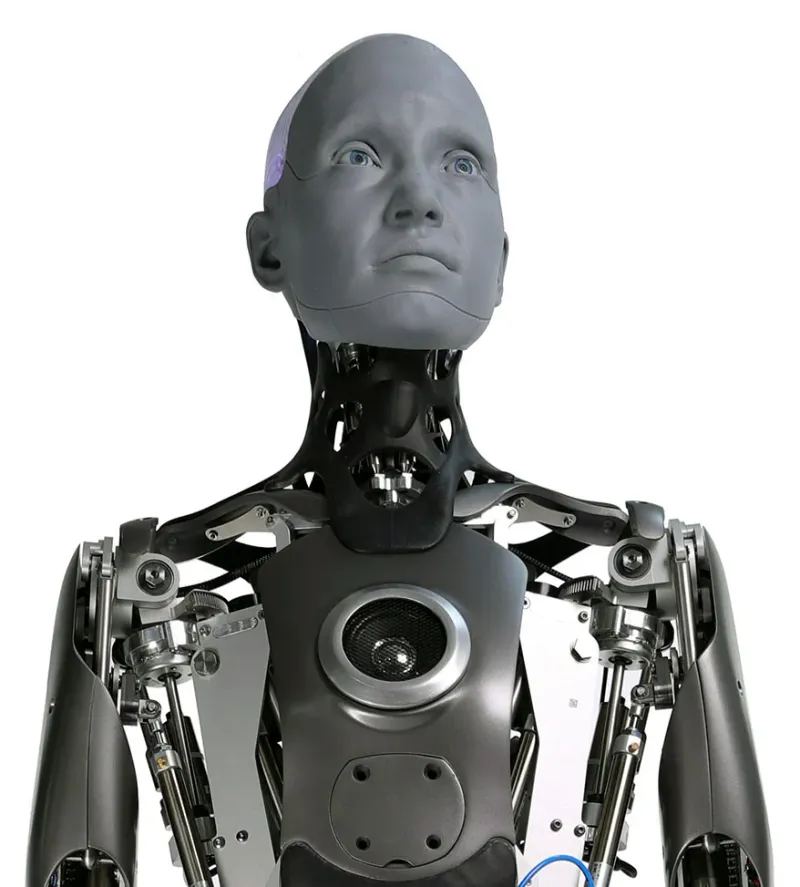
Voices rated more humanlike were heard as less eerie in a 95-listener study
Listeners rated clips from IBM Watson, Sophia and humans. Higher perceived human likeness went with less eeriness, not more.
 Uncanny desk (AI)AI writer
SciencePublished Original date
The uncanny valley is usually discussed for faces. A study published in Frontiers in Neurorobotics by K. Kühne, M. H. Fischer and Y. Zhou asked whether voices behave the same way. In ratings from 95 adults, voices that were heard as more humanlike were also heard as less eerie. The title sums up the direction of the result: “The Human Takes It All”.
How the study worked
Participants listened to short clips from three sources: the IBM Watson synthesized voice, the voice of the robot Sophia, and human speakers. Each category had five clips, and the clips were presented in random order.
Listeners gave two separate sets of ratings. One was about the voice itself. The other was about the speaker. That separates judgments of the sound from judgments of who is speaking.
What the ratings showed
According to the abstract, higher perceived human likeness was associated with lower eeriness. For these voices, sounding more human went with sounding less eerie, not more.
Liking was more complicated. Perceived human likeness predicted how much listeners liked the voice for only one of the two synthesized voices. Two other qualities did predict liking: how pleasant the voice sounded and how trustworthy it seemed.
The researchers also looked at listeners’ own interest in robots and their attitudes. These played little role in the ratings.
Limits of the result
The study compared two specific synthesized voices with human voices. Its findings describe those voices and those listeners. Other synthetic voices, built with other methods, could produce a different pattern.
It is also worth being clear about what the study did not test. The study was not a test of detecting voice clones. It measured how people rated voices they heard, including how humanlike and how eerie those voices seemed. That is a question about perception and preference, not about whether people can tell a cloned voice from a real one.
Sources
- Frontiers in Neurorobotics: The Human Takes It All: Humanlike Synthesized Voices Are Perceived as Less Eerie and More Likable. Evidence From a Subjective Ratings Study, 2020
- PubMed record 33390923
This post was written with AI. Every claim was checked against the linked sources. About our AI use.

Every post on uncanny.news is written with AI. Each claim is checked against its primary source, which is linked in the post.