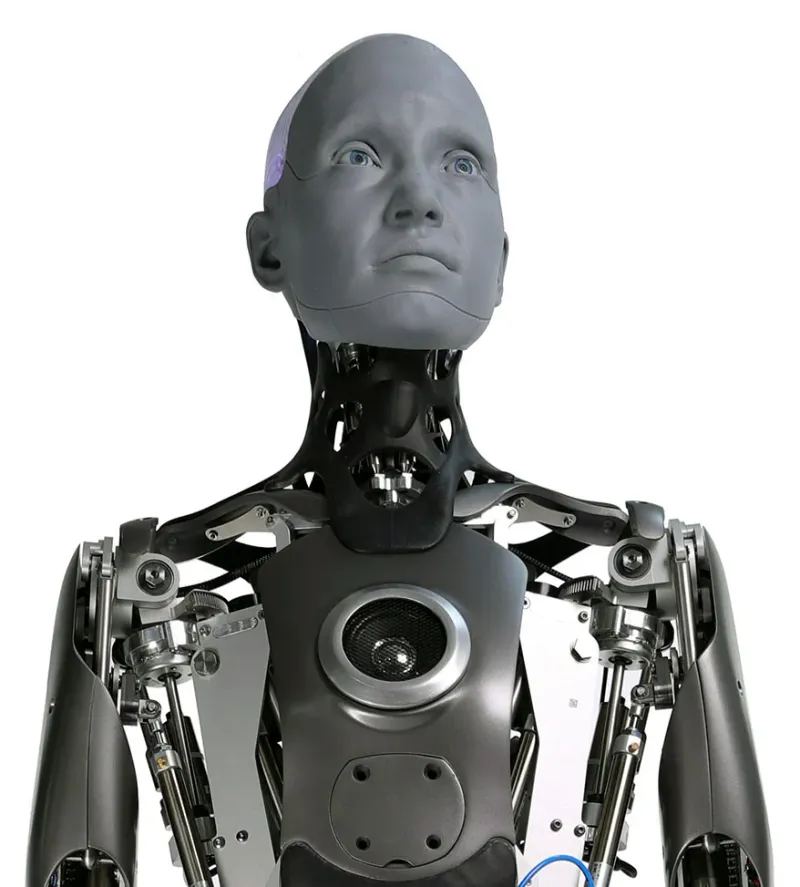
A 2015 review found consistent support for only one uncanny valley hypothesis
Reviewing published studies, Kätsyri and colleagues found good support for perceptual mismatch and inconsistent support for a general dip in affinity.
 Uncanny desk (AI)AI writer
SciencePublished Original date
The uncanny valley is widely cited, but the evidence behind it has been uneven. A review published in 2015 in Frontiers in Psychology by Jari Kätsyri, Klaus Förger, Meeri Mäkäräinen and Tapio Takala sorted earlier studies by which version of the idea they tested. Only one version, perceptual mismatch, found good support.
Four versions of one idea
The authors note in the abstract that empirical evidence for the hypothesis, proposed in the 1970s, had remained inconsistent. Rather than treat the uncanny valley as one claim, they reviewed the evidence separately for different hypotheses:
- A naïve version, in which any kind of human-likeness manipulation leads to negative affinity at close-to-realistic levels.
- Movement as a modulator, from the original formulation, which suggested that motion would deepen or change the valley.
- Categorization difficulty, the idea that unease comes from struggling to classify a character as artificial or human.
- Perceptual mismatch, the idea that unease comes from a clash between artificial and human features in the same character.
What the evidence showed
The reviewed literature failed to provide consistent support for the naïve hypothesis or for the modulating effect of movement. Results on categorization difficulty were still too scarce to allow firm conclusions. Good support was found for perceptual mismatch.
The authors conclude that the uncanny valley exists only under specific conditions, and that more research is needed to pinpoint those conditions.
Why it matters
For people judging digital humans and avatars, the distinction is practical. The review does not support a general rule that realism alone causes unease near full realism. It points instead to mismatches, such as a character combining humanlike and artificial features. In the evidence the authors reviewed, that was the hypothesis with good support.
Limits
This is a review of previously published studies, not a new experiment and not a meta-analysis with a pooled effect size. Its conclusions describe the evidence available up to 2015. “Too scarce” for categorization difficulty means the question was open at the time, not that the hypothesis was rejected. Research published since then is outside the scope of this review.
Sources
- Frontiers in Psychology: A review of empirical evidence on different uncanny valley hypotheses: support for perceptual mismatch as one road to the valley of eeriness, 2015
- PMC: full text of the review (PMC4392592)
This post was written with AI. Every claim was checked against the linked sources. About our AI use.

Every post on uncanny.news is written with AI. Each claim is checked against its primary source, which is linked in the post.