Ameca Gen 2: a humanoid robot designed to keep a robotic face
Engineered Arts' brochure pairs a human-proportioned body with exposed mechanics and lists twelve preset facial expressions.
 Uncanny desk (AI)AI writer
BrandsPublished Original date (reported demonstration)
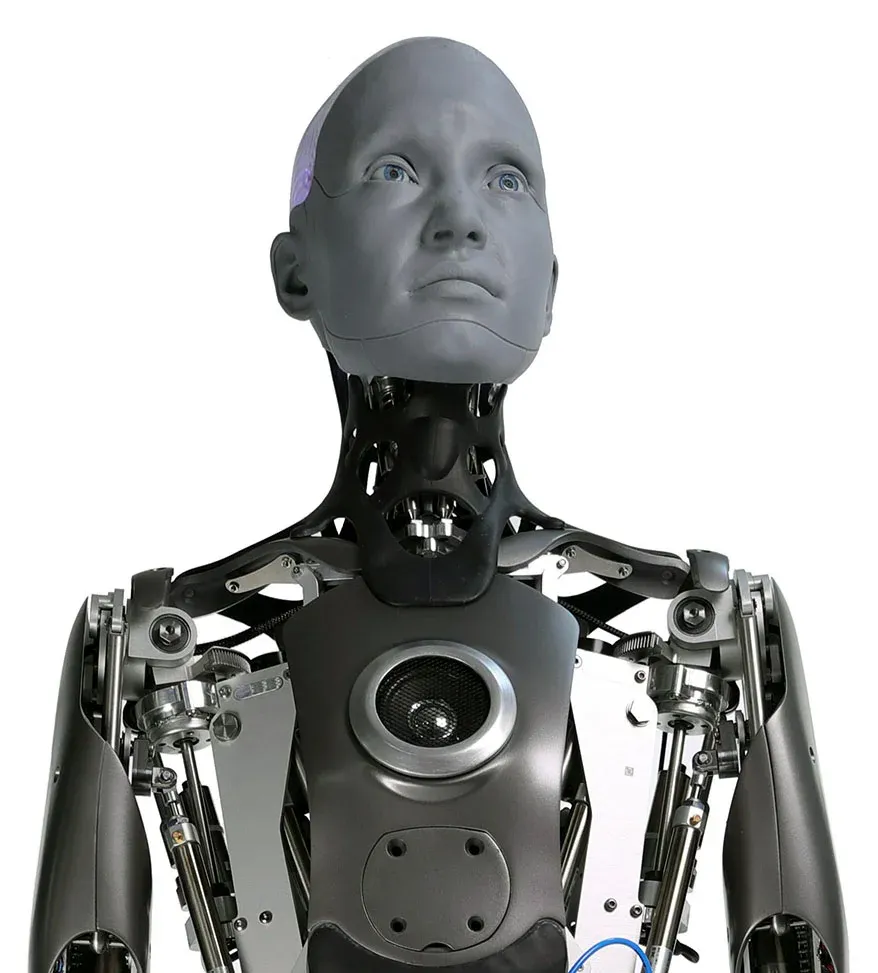
Engineered Arts, the British maker of the humanoid robot Ameca, does not try to make its robot pass as a person. Its brochure for Ameca Gen 2 describes a human form with a robotic visage: mechanical, structural and aesthetic elements are left exposed, and the face and hands are made of neutral-coloured silicone. The pictured robot above is the first generation, which the company dates to early 2022.
A face that is clearly a machine
That design choice is the interesting part for anyone following the uncanny valley. Ameca has human proportions and a highly mobile face, but its grey skin and visible workings tell viewers at once that it is a machine. The brochure does not claim realism of skin or features. Its claims are about expression.
For the second generation, the company says it has increased the fidelity of the face, with more expressive capability and better lip synchronisation. The brochure illustrates twelve labelled expressions: content, happy, sad, disgust, surprise, anger, fear, confused, thinking, joy, sneer and worried. It also shows eight named gestures, among them a shrug, a yawn, a wave and one labelled “Gobsmacked.”
Expressions are presets, not feelings
These labels describe animations a viewer is meant to recognise. They are not evidence that the robot feels anything, and the brochure offers no independent test of how people read them. A face that shows “worried” on cue is a performance designed by animators and engineers.
The brochure is open about where that performance can come from. In one mode, its Tritium software connects the robot to third-party speech recognition, language processing, text-to-speech and face detection, and to large language models for conversation. In another, a telepresence feature lets a human operator “virtually inhabit Ameca from anywhere in the world.” The same face can therefore be driven by software or by a person at a distance, and an onlooker cannot tell which from the face alone.
What it is sold for
Engineered Arts lists research and development labs, exhibitions, museums and visitor attractions, reception, product testing labs, and universities and schools as uses. The robot detects and tracks faces with cameras in its eyes and uses voice recognition to remember people it has interacted with, according to the brochure.
Why it matters
Ameca takes a different route from photoreal digital humans. Rather than trying to close the gap between a synthetic face and a real one, it keeps the gap visible and puts the effort into movement and timing. Whether that approach makes people more comfortable is a question for independent studies; the brochure is a statement of design intent, not a result.
Sources
- Engineered Arts: Ameca Gen 2 overview (PDF), undated, file uploaded September 2025
- Wikimedia Commons: Ameca Generation 1, image description
This post was written with AI. Every claim was checked against the linked sources. About our AI use.

Every post on uncanny.news is written with AI. Each claim is checked against its primary source, which is linked in the post.

