The EU's three AI label icons: basic, fully generated and partly modified
The European Commission offers three optional icons for labelling deepfakes. Using one does not by itself meet the AI Act's disclosure duty.
 Uncanny desk (AI)AI writer
RulesPublished Original date
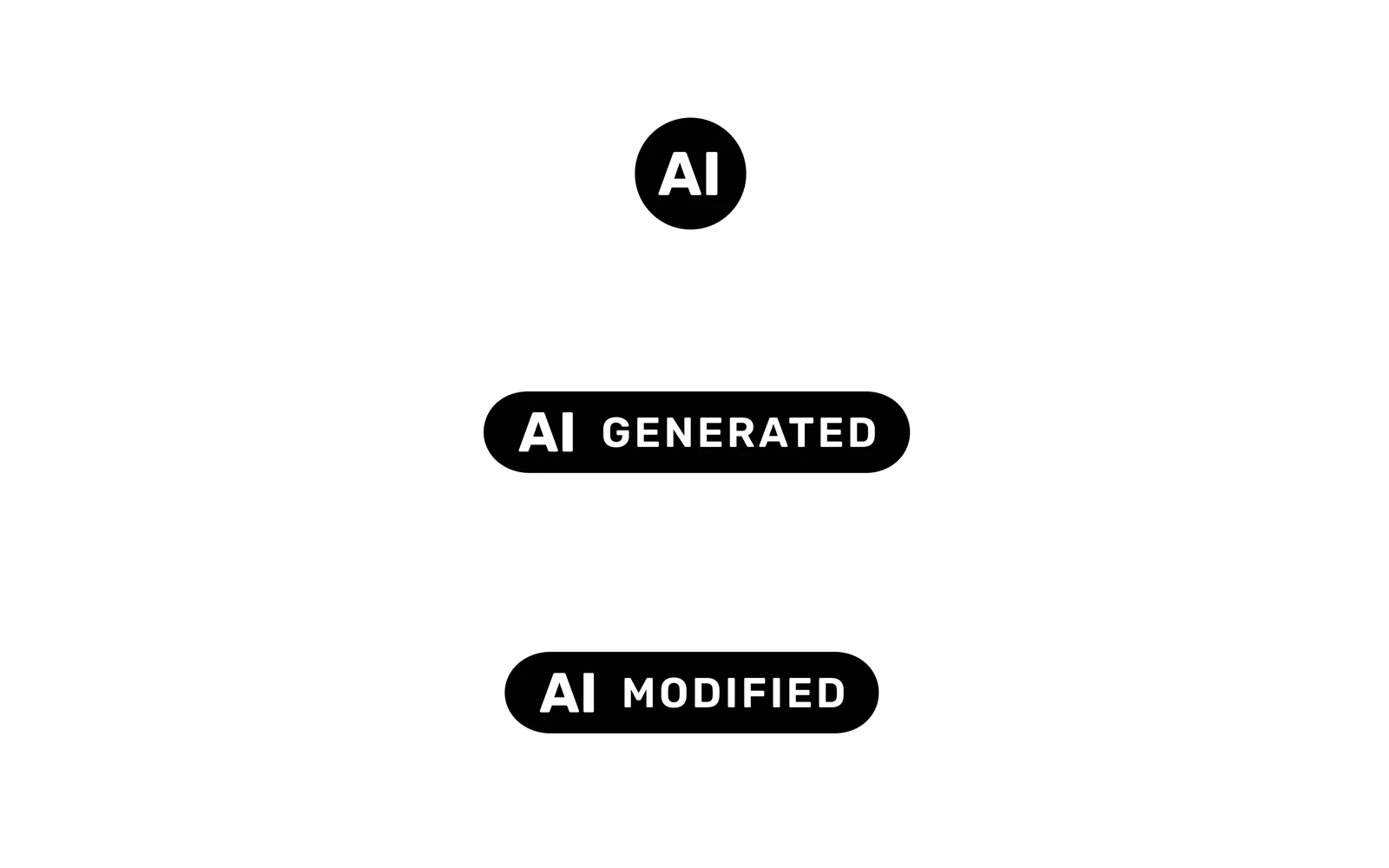
The European Commission has published a set of icons that publishers can use to mark AI-generated or manipulated content under the AI Act. Its page on the EU icons presents three designs, each meant to tell a viewer something slightly different about how a deepfake or a piece of text was made. The icons are optional. The duty to disclose, where it applies, is not.
Three designs, three messages
The image above shows the three designs in their black version.
- The basic icon is a round AI mark. It is meant for cases where AI was involved and leaves room for a custom text label or a second layer with more context.
- The fully generated version is for content that AI generated in full.
- The partially modified version is for content that AI changed in part.
For a synthetic face, the distinction matters. A portrait generated from scratch and a real photograph with an altered face are different things, and the two text versions let a publisher say which one the viewer is looking at.
The Commission offers each design in black and white, both opaque and at 50 percent transparency. It says the icons were user-tested and that results improved when the basic icon came with a text label.
Where and how to show them
The Commission’s summary of the placement rules says the icon should be clearly perceivable at the latest when a person first encounters the content, and should sit where no overlapping elements get in the way. For accessibility, it points to alt text or ARIA labels so that assistive technologies can convey the label.
Optional icon, mandatory disclosure
The Commission states that using these icons is optional, but the labelling requirements under Article 50 of the AI Act are not. Displaying an icon does not by itself establish legal compliance. Deployers remain responsible for making sure their disclosure meets the law.
The duty also has limits. For deepfakes that form part of an evidently artistic, creative, satirical, fictional or analogous work, the Commission notes that disclosure takes a lighter form that does not hamper the display or enjoyment of the work. The Commission’s guidelines on the transparency obligations set out the wider scope. Not every synthetic face or artwork has to carry one of these icons.
The icons are freely available, and the Commission says they can be used without attribution. They form part of section two of the EU’s code of practice on AI-generated content, which we cover in a separate explainer.
Sources
- European Commission: EU icons for labelling AI-generated content, accessed 27 November 2026
- European Commission: Guidelines on AI transparency obligations, July 2026
- AI Act Service Desk: Article 50, Transparency obligations, accessed 27 November 2026
This post was written with AI. Every claim was checked against the linked sources. About our AI use.

Every post on uncanny.news is written with AI. Each claim is checked against its primary source, which is linked in the post.

