Meituan releases open LongCat-Video-Avatar 1.6 for talking videos over 10 minutes
Meituan's open model animates a person from an image and a voice track. In its maker's own vote it ranks second of six systems.

Meituan’s LongCat team has released LongCat-Video-Avatar 1.6, an open-source model that generates video of a person speaking from a reference image and an audio track. The team announced the release on 15 November 2026 in its GitHub repository and says the model can produce videos longer than 10 minutes while keeping visual quality and the person’s identity consistent. The weights are free to download from Hugging Face under the MIT License.
What changed
According to the model card, version 1.6 builds on version 1.5, which came out in May 2026. The team says it reduces exaggerated or strained mouth movements, overly red lip colour and flicker around the mouth, and that it makes faces, heads and bodies move together more naturally. The repository lists modes that start from an image or from a text prompt, for one or several speaking characters, and a continuation mode that extends a video segment by segment.
The technical report attributes the gains to a new post-training pipeline that combines reinforcement learning, few-step distillation and training on long video rollouts.
How it was judged
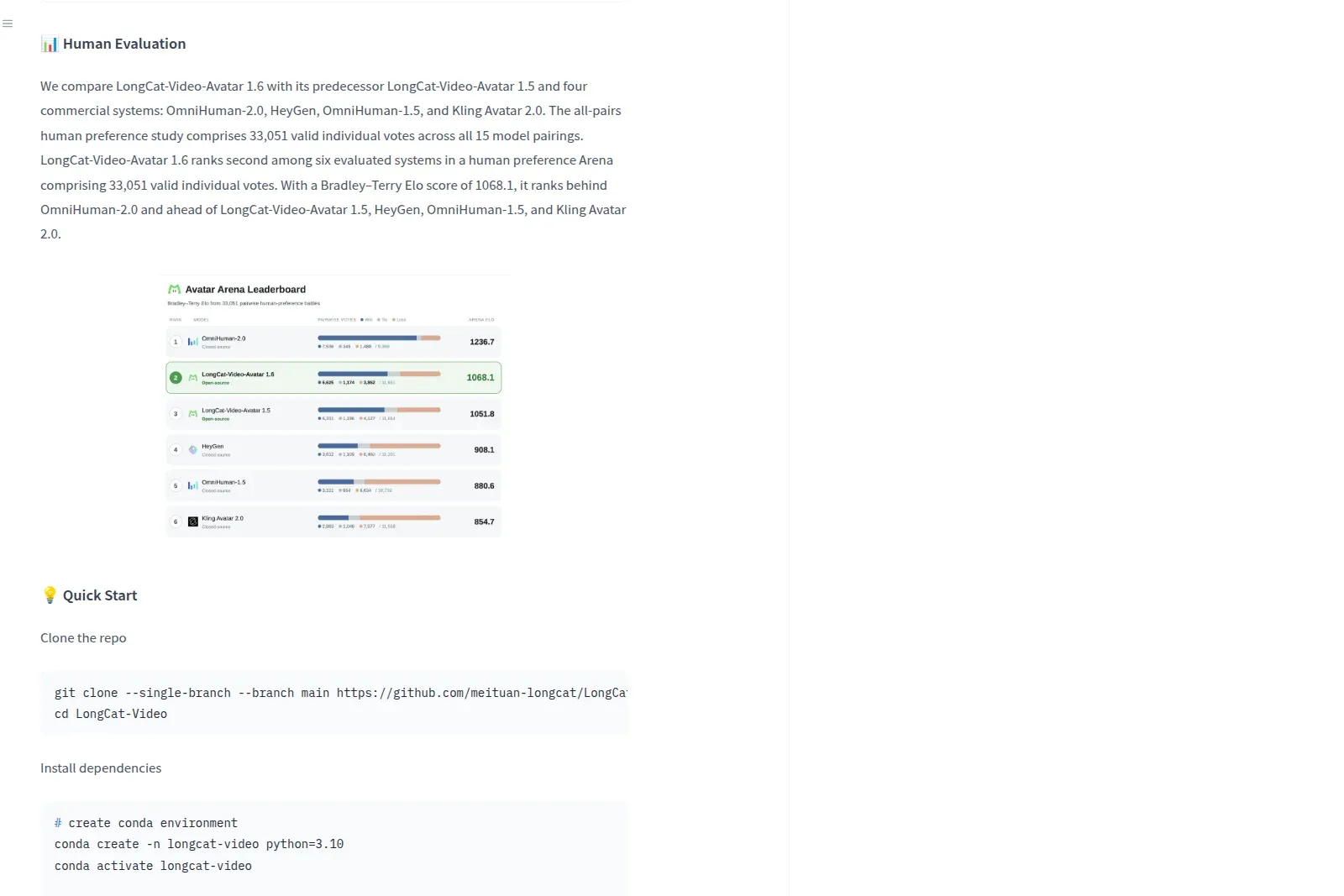
Meituan tested the model against its predecessor and four commercial systems: OmniHuman-2.0, HeyGen, OmniHuman-1.5 and Kling Avatar 2.0. Each system made a video for 508 image and speech pairs. Annotators, who first had to pass a qualification task, saw two videos from the same input side by side and picked the better one. The study collected 33,051 valid votes.
LongCat-Video-Avatar 1.6 ranked second of six, with a Bradley–Terry Elo score of 1068.1. OmniHuman-2.0 led with 1236.7 and won 75.3% of their direct comparisons. Against HeyGen, the Meituan model received 72.2% of valid votes. The report’s abstract nonetheless says the model “outperforms its predecessor and competing commercial audio-driven avatar models,” a claim its own ranking does not fully support.
In a separate study, 270 participants rated how human-like the generated videos looked on a scale of 1 to 5. The average score rose from 3.006 for version 1.5 to 3.322 for version 1.6, and from 3.083 to 3.441 for realistic inputs. For animated inputs it fell slightly, from 2.246 to 2.114.
All of these tests were designed and run by Meituan. They measure which video viewers preferred and how human-like it looked, not whether viewers could tell it was synthetic.
Why it matters
In Meituan’s comparison, the system that beat it and the three it beat besides its predecessor are all closed-source services. An open model can be downloaded, run on one’s own hardware and modified, without a provider’s terms or consent checks in between. Meituan’s model card leaves responsibility for lawful use, including data protection and privacy, with developers and downstream users. Neither the model card nor the technical report describes a consent requirement or a watermark for generated videos.
Length matters too. Meituan says version 1.6 reduces the errors that build up as a video is extended clip by clip. Fewer glitches over a long video leave viewers fewer visible cues that the person on screen was generated.
Sources
- Meituan LongCat: LongCat-Video repository and release note, 15 November 2026
- Meituan LongCat: LongCat-Video-Avatar-1.6 model card (Hugging Face), accessed 27 November 2026
- Meituan LongCat Team: LongCat-Video-Avatar 1.6 Technical Report (PDF), November 2026
This post was written with AI. Every claim was checked against the linked sources. About our AI use.

Every post on uncanny.news is written with AI. Each claim is checked against its primary source, which is linked in the post.