HeyGen's Avatar 6 test: raters judged 65.1% of avatar clips real, 78.9% of real ones
In HeyGen's own Turing test, its new avatar model came close to real recordings of the same people but did not match them.

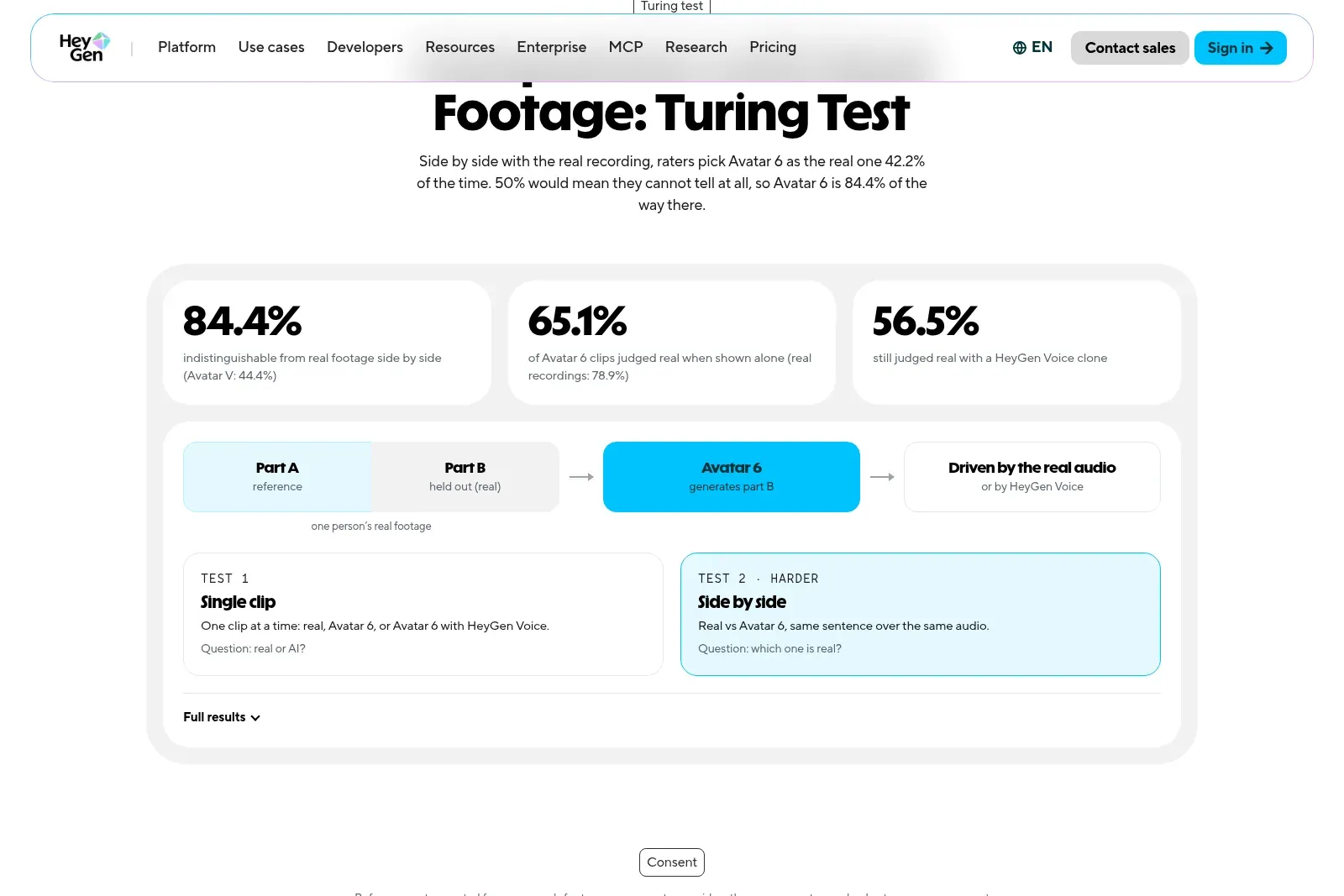
When external raters saw single clips of people talking, they judged 65.1% of the clips made by HeyGen’s new Avatar 6 model to be real, against 78.9% of genuine recordings of the same people. HeyGen, the AI video company, reported the figures in a technical report on Avatar 6 published on 17 November 2026. The model generates talking videos from a single photo, optionally with a short recording of the person as an identity reference.
How the test worked
According to the full report (PDF), HeyGen used real recordings of its own employees. Each recording was split in two: one part served as the reference for Avatar 6, and the other was held back as the real comparison. Avatar 6 then generated its own version of the held-back part.
Twenty external raters took part, with about four raters per clip or pair. The single-clip test covered 77 people and the side-by-side test 76. The median evaluated segment was 28.6 seconds long.
There were two tests:
- In the single-clip test, raters saw one clip at a time and answered “real or AI?”. Real recordings were judged real in 78.9% of 612 answers. Avatar 6 driven by the person’s own voice was judged real in 65.1% of 304 answers. With a HeyGen Voice clone instead of the real voice, the figure was 56.5% of 308 answers.
- In the side-by-side test, raters saw the real clip and the Avatar 6 clip saying the same sentence over the same audio, and picked the real one. They picked the Avatar 6 clip in 42.2% of their choices, 114 of 270.
HeyGen doubles that last figure into what it calls an “indistinguishability rate” of 84.4%, where 100% would mean raters could not tell the two apart at all. Measured the same way, its previous model, Avatar V, reached 44.4%.
What the numbers say
The report states its main result in its own words: Avatar 6 “comes close to real footage in a Turing test with external raters.” The gap between 65.1% and 78.9% shows it did not close it. Even the real recordings were judged AI in about one answer in five, so raters in this setting were wary of every clip.
The test is HeyGen’s own. The raters judged short clips of HeyGen employees, whose real footage the model had partly seen as reference. Elsewhere in the report, HeyGen employees also judged which of several generated videos looked most like themselves. Those are company-run comparisons, not an independent study.
Consent before rendering
The report also describes a consent check. Before an avatar created from a person’s footage can generate any video, the person must record a short on-camera consent statement that includes a one-time code for that session. HeyGen then checks that the person in the consent recording matches the person in the footage, and the avatar cannot render until the check passes. HeyGen says everyone shown in the report is an employee or contracted actor who consented.
Why it matters
Turing-style tests are becoming a standard way for avatar companies to describe progress. HeyGen’s numbers show how close a generated face and voice can come to the real person when a viewer sees a short clip on its own. They also show that a voice clone made the clips less convincing: 56.5% judged real, against 65.1% with the person’s own voice.
Sources
- HeyGen Research: Avatar 6: Talking Avatars That Are More Like You, 17 November 2026
- HeyGen: Avatar 6 Technical Report (PDF), 17 November 2026
This post was written with AI. Every claim was checked against the linked sources. About our AI use.

Every post on uncanny.news is written with AI. Each claim is checked against its primary source, which is linked in the post.