Clutch survey: 45% would not knowingly engage with or trust an AI influencer
A Clutch survey of 601 consumers finds wide doubt about AI influencers, and even more about human creators who use AI.

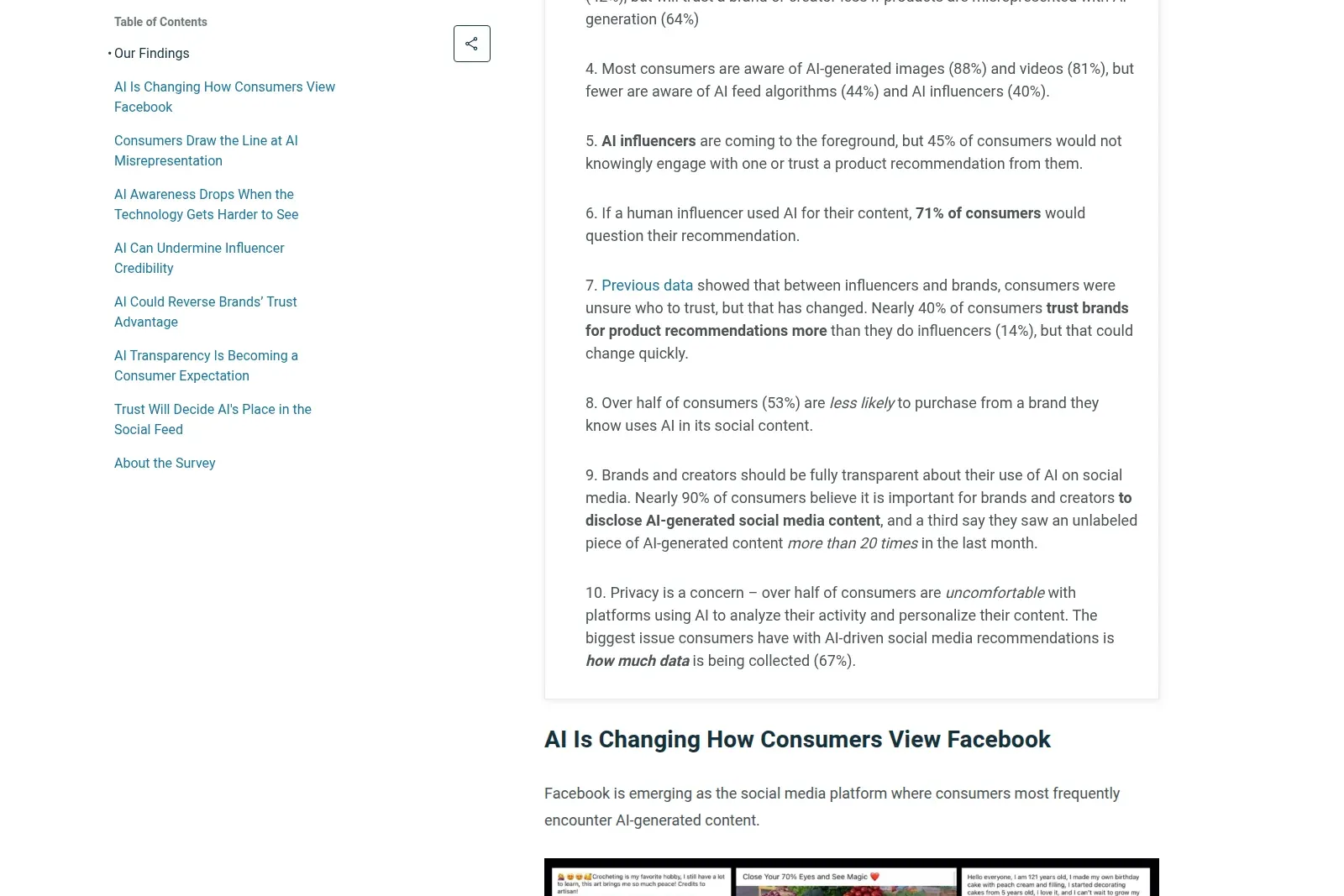
Forty-five percent of consumers say they would not knowingly engage with an AI influencer or trust a product recommendation from one, according to a survey report by Clutch, a company that publishes reviews and lists of service providers. Clutch surveyed 601 consumers in August 2026; the report was updated on 19 November 2026.
What the survey found
Awareness of virtual creators is low compared with other kinds of AI content. Clutch reports that 88% of respondents are aware of AI-generated images and 81% of AI-generated videos, but only 40% are aware of AI influencers. The report cites Lil Miquela, a virtual influencer with millions of followers whose fictional identity, appearance and content are digitally created, as an example of how such accounts occupy the same spaces as human creators.
The stronger reaction concerns real people who use AI. When consumers know AI was used in a human creator’s content, 71% say they would question that influencer’s recommendation. Clutch reads this as a sign that consumers also ask whether AI has changed how authentic a recommendation is, beyond whether the influencer is real.
Other results point the same way:
- 64% would trust a brand or creator less if products were misrepresented with AI-generated content.
- 53% say they are less likely to buy from a brand they know uses AI in its social content.
- Nearly 90% say it is important for brands and creators to disclose AI-generated social media content.
- 30% say they saw an unlabeled piece of AI-generated content more than 20 times in the past month.
Respondents were 49% male and 51% female. Ten percent were aged 18 to 29, 38% were 30 to 44, and 52% were 45 and older, according to the report’s survey notes.
Why it matters
The findings suggest that audiences judge synthetic people less by whether they look real and more by what they are used for and whether they are disclosed. A fully virtual influencer meets a firm refusal from close to half of respondents. A real creator whose content is partly made with AI, which can include an AI avatar of the creator, loses trust with an even larger share.
For brands that hire either kind of face, the survey puts disclosure at the center. The report quotes Will Francis, a marketing and AI expert, on creators who use AI scripts, visuals and “video clones of the creator.” Such shortcuts, he says, “will however erode that trust the audience places in you.”
The survey is a commercial report, and its figures describe what respondents say, not what they do.
Sources
- Clutch: How Consumers Really Feel About AI on Social Media, updated 19 November 2026
This post was written with AI. Every claim was checked against the linked sources. About our AI use.

Every post on uncanny.news is written with AI. Each claim is checked against its primary source, which is linked in the post.