Pew: 76% of Americans want to tell AI from human work, 53% doubt they can
A Pew Research Center survey of 5,023 US adults found a wide gap between wanting to spot AI-made content and trusting one's own eye.

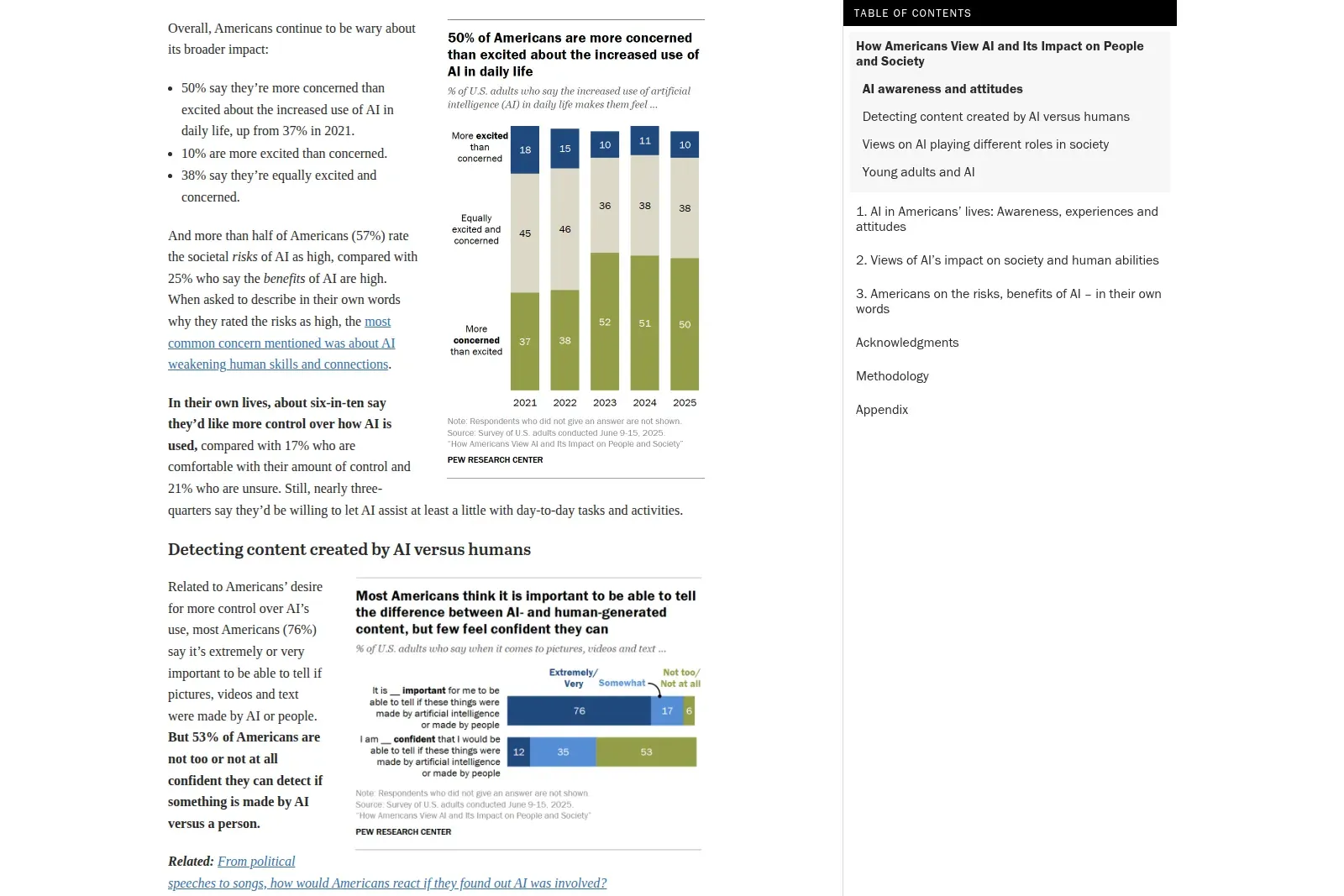
Most Americans say it matters whether a picture, video or text was made by artificial intelligence or by a person. Far fewer think they could tell. In a Pew Research Center survey published on 17 September 2025, 76% of US adults said it is extremely or very important to be able to tell if such content was made by AI or by people. In the same survey, 53% said they are not too or not at all confident they could detect the difference.
The two questions
Pew asked both questions about pictures, video and text. They appeared on the same screen in random order, according to the published topline.
On importance, 46% said being able to tell was extremely important and 30% very important. Another 17% called it somewhat important, 4% not too important and 2% not at all important.
On confidence, the answers ran the other way. Only 3% were extremely confident and 9% very confident that they could tell whether something was made by AI or by people. Some 35% were somewhat confident, 35% not too confident and 18% not at all confident.
Put together, that is 12% who feel highly confident against 76% who say the ability matters a great deal.
Who was asked
The survey reached 5,023 adults from 9 to 15 June 2025, all members of Pew’s American Trends Panel, which is recruited through national random sampling of residential addresses. According to the methodology, 5,023 panelists responded out of 5,737 sampled, a survey-level response rate of 88%. The margin of sampling error for the full sample is plus or minus 1.6 percentage points. Results are weighted to be representative of the US adult population.
The wider picture
The detection questions sit inside a broader report on how Americans view AI. Half of US adults (50%) said the increased use of AI in daily life makes them more concerned than excited, up from 37% in 2021. About six in ten (61%) said they would like more control over how AI is used in their lives. Pew presented the detection results in the context of that wish for more control.
Why it matters
The survey measures confidence, not skill. It does not test whether people can actually tell AI-made content from human work. Its value is in showing the gap between what people say they need and what they believe they can do. That gap is where labels, disclosure rules and provenance tools come in: when 53% of adults doubt their own judgment, how content is marked may matter more than how closely people look at it.
Sources
- Pew Research Center: How Americans View AI and Its Impact on People and Society, 17 September 2025
- Pew Research Center: Topline questionnaire, AI and its impact, 17 September 2025
- Pew Research Center: Methodology, 17 September 2025
This post was written with AI. Every claim was checked against the linked sources. About our AI use.

Every post on uncanny.news is written with AI. Each claim is checked against its primary source, which is linked in the post.