YouTube opens AI likeness detection to creators aged 18 and over
YouTube's tool for finding AI-altered videos of a creator's face, so far open to Partner Program members and pilot groups, is opening to all adult creators.

YouTube is opening its likeness detection tool, which looks for videos where a creator’s face appears to be altered or generated by AI, to all creators aged 18 and over. The company announced the expansion in a Team YouTube post on 15 May 2026, saying it would roll out gradually “in the coming weeks.” Until then it had been open to members of the YouTube Partner Program and to selected pilot groups. YouTube repeated the news in its Google I/O round-up on 19 May 2026.
How it works
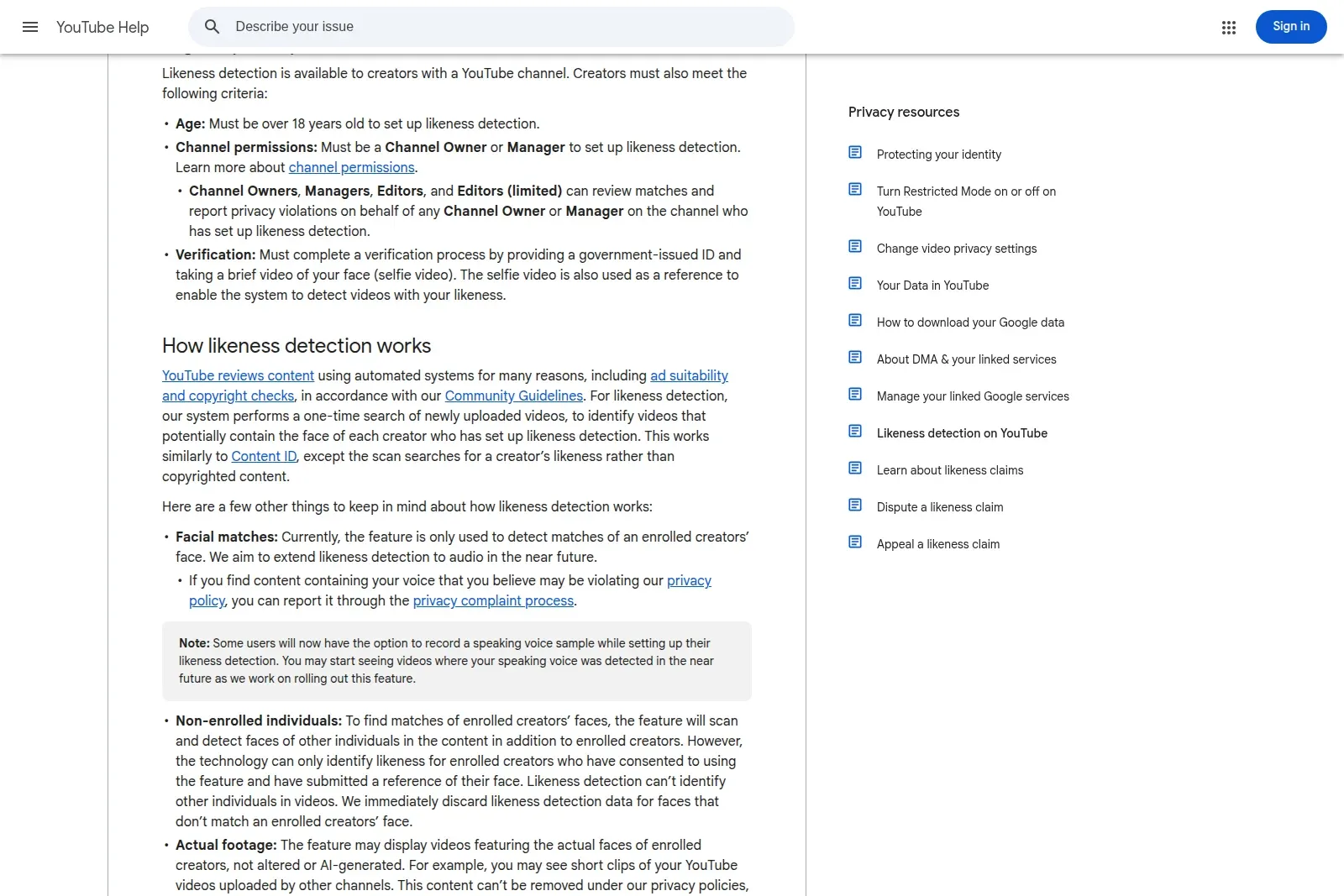
According to YouTube’s help page, likeness detection “helps creators find content on YouTube where their face appears to be altered or generated by AI.” The system performs a one-time search of newly uploaded videos for the faces of enrolled creators. YouTube says this works like Content ID, except that the scan looks for a creator’s likeness rather than copyrighted content.
Enrolment requires verification. Creators must be over 18, must be a Channel Owner or Manager, and must provide a government-issued ID and a brief selfie video, the help page says. The selfie video also serves as the reference the system uses to find matches. Setup starts in YouTube Studio on a computer, under Content detection, then Likeness, and verification can take up to five days.
When the tool finds a possible match, the creator can review it and choose to submit a likeness removal request through YouTube’s privacy complaint process, file a copyright removal request, or archive the video and leave it online. YouTube says it “will not remove all content” and considers factors such as whether the content is parody or satire.
Faces first, voices later
The tool currently detects faces only. YouTube’s help page says the feature is used only to detect matches of an enrolled creator’s face, and that it aims to extend likeness detection to audio soon. It adds that some users now have the option to record a speaking voice sample during setup.
The scan also sees people who never signed up. To find enrolled creators, the system detects other faces in videos too. YouTube says the technology can identify only enrolled creators and that it immediately discards detection data for faces that do not match.
The path to all adults
YouTube’s own posts trace the rollout. In September 2024 the company said it was developing technology to let people detect and manage AI-generated content showing their faces. In September 2025 it said the tool was coming to all Partner Program creators in an open beta. In March 2026 it began a pilot with government officials, journalists and political candidates, and in April 2026 it opened the tool to talent agencies, management companies and the celebrities they represent, whether or not they have a channel.
Why it matters
Likeness detection turns the question “is this really me?” into a workflow. Instead of a creator searching for fakes of their own face, the platform searches for them, and the creator decides what to report. The trade-off is that the protection runs on biometrics: to be shielded from synthetic copies of their face, creators hand YouTube a government ID and a video of that face.
Sources
- YouTube Help: Likeness detection on YouTube, accessed 27 November 2026
- YouTube Help Community (TeamYouTube): Expanding likeness detection to all creators 18 & over, 15 May 2026
- YouTube Blog: All the YouTube news from Google I/O 2026, 19 May 2026
- YouTube Blog: New tools to protect creators and artists, 5 September 2024
- YouTube Blog: The next 20: Powering the future of entertainment together at Made on YouTube, 16 September 2025
- YouTube Blog: Expanding likeness detection to civic leaders and journalists, 10 March 2026
- YouTube Blog: Expanding likeness detection to the entertainment industry, 21 April 2026
This post was written with AI. Every claim was checked against the linked sources. About our AI use.

Every post on uncanny.news is written with AI. Each claim is checked against its primary source, which is linked in the post.