The 1970 essay that named the uncanny valley
Masahiro Mori's short 1970 essay drew the curve behind the uncanny valley. Its first authorized English translation appeared in 2012.

The uncanny valley began as a three-page essay. Masahiro Mori, then a robotics professor at the Tokyo Institute of Technology, published it in the Japanese journal Energy in 1970 (vol. 7, no. 4, pp. 33–35). In 2012, IEEE Spectrum published the first English translation authorized and reviewed by Mori, by Karl F. MacDorman and Norri Kageki. The translation had first appeared in the June 2012 issue of IEEE Robotics & Automation Magazine.
According to the editor’s note, the essay drew almost no attention for years after it appeared, and a complete version was hard to find, although copies circulated among researchers.
The curve
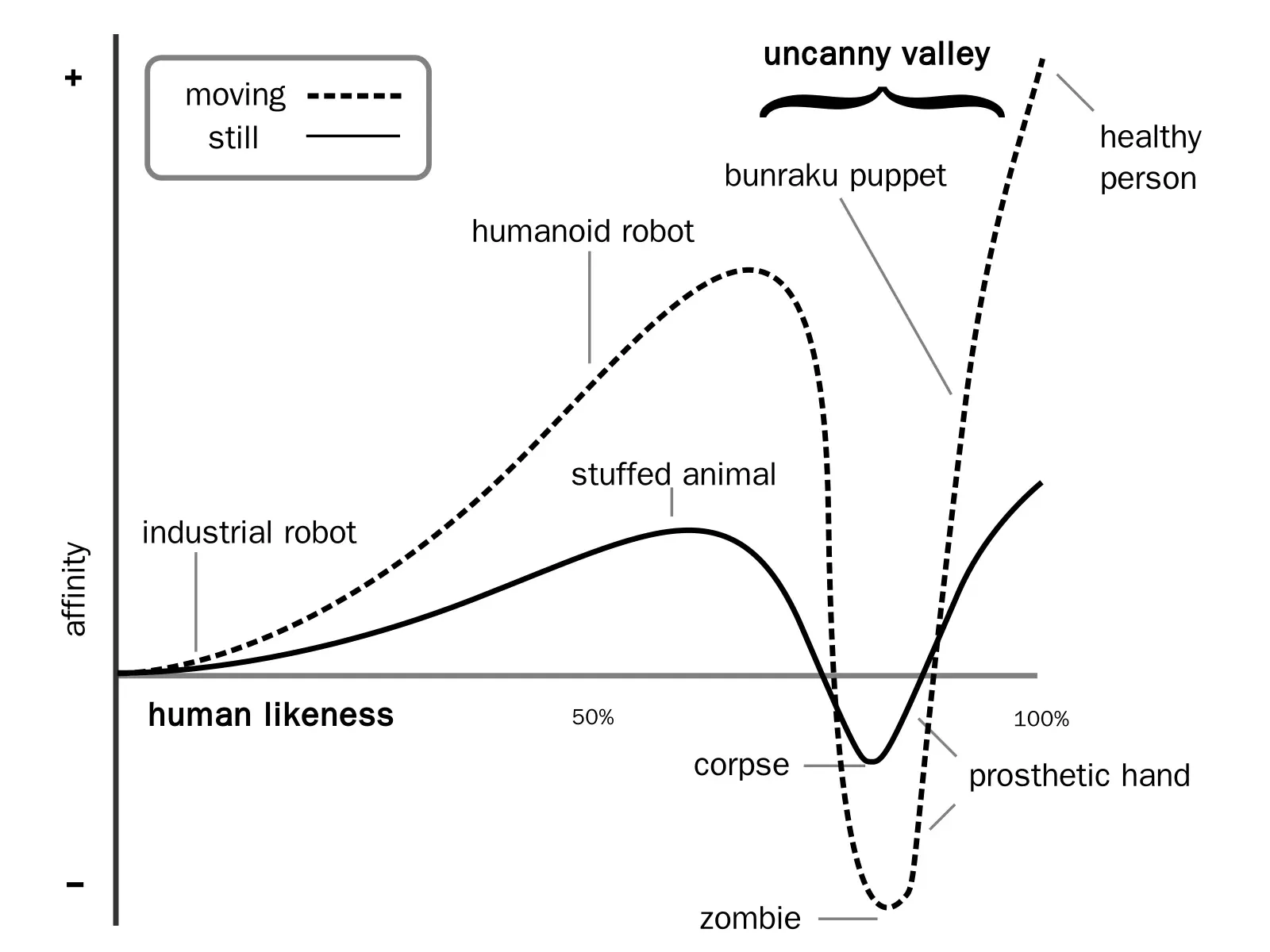
Mori starts from a mathematical idea. Most everyday relations rise steadily, the way a car speeds up as the accelerator is pressed. Our response to humanlike machines, he argues, does not work that way. As robots are made to look more human, our affinity for them grows, then falls into a dip before rising again. That dip is the valley in his title.
He places examples along the curve. An industrial robot, with no face or legs, sits near the origin. A toy robot with a face, arms and legs sits halfway up the first hill. A realistic prosthetic hand sits near the bottom of the valley. Mori describes the shock of discovering that a hand that looked real is artificial, for example during a handshake, when its “limp boneless grip” and its coldness give it away. At that point, he says, affinity turns negative. A bunraku puppet, seen from a theatre seat, can rank high despite its limited realism, because the audience takes in its overall appearance and movement rather than its size or skin.
Movement makes it steeper
Movement, in Mori’s account, amplifies both the peaks and the valley. A prosthetic hand near the bottom of the valley feels eerier once it starts to move. He cites a robot built for the 1970 World Exposition in Osaka with 29 pairs of artificial muscles in its face. According to its designer, the speed of a smile decides how it reads: when the robot’s smile was slowed to half speed, “instead of looking happy, its expression turns creepy.”
Design advice and an explanation
Mori’s advice to designers was to aim for the first peak, not the second: a moderate degree of human likeness that still earns real affinity. He predicted that a deliberately nonhuman design could reach a safe level of affinity, and pointed to eyeglasses, which do not resemble eyeballs, and to a wooden hand carved by a sculptor of Buddha statues.
His explanation was tentative. He linked the valley to death, the move from a moving, living person to a still corpse, and said he was sure the feeling belongs to our instinct for self-preservation, while admitting he had not studied the question deeply. A footnote suggests the eeriness protects against nearby sources of danger, such as corpses and members of different species.
Why it still matters
The essay was a hypothesis drawn as a graph, not the result of an experiment. Mori ended by asking researchers to build an accurate map of the valley. Later studies test pieces of that map. A 2018 set of six replication studies, for example, found the effect with photorealistic robot pictures but not with morphed computer-generated images. The original text is short and worth reading before any claim that a face has crossed the valley.
Sources
- IEEE Spectrum: The Uncanny Valley: The Original Essay by Masahiro Mori, 12 June 2012
- Heliyon via PubMed Central: Evaluating the replicability of the uncanny valley effect, 26 November 2018
This post was written with AI. Every claim was checked against the linked sources. About our AI use.

Every post on uncanny.news is written with AI. Each claim is checked against its primary source, which is linked in the post.