Tavus says 48% of test callers took its Griffin video avatar for a real person
In a one-minute video call study, 26 of 54 participants believed Tavus's Griffin-Lite was human, against 2.4% for the company's previous model.

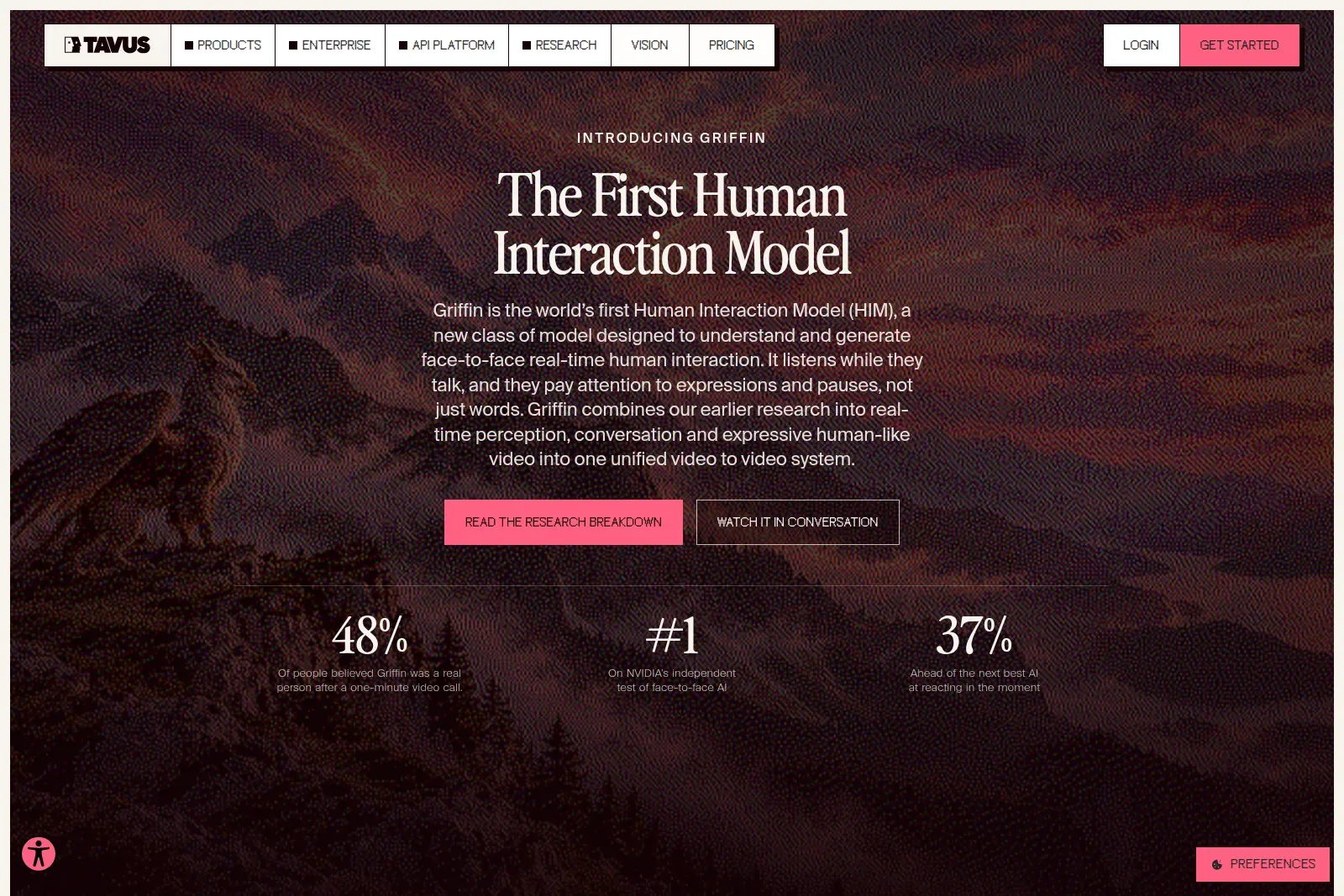
Video AI company Tavus says 26 of 54 people who had a one-minute video call with its new model, Griffin-Lite, believed they had spoken with a real person. That is 48%, against 2.4% of 41 participants for its previous model, Phoenix-4.5. Tavus published the results with the Griffin announcement on 1 October 2026 and calls Griffin “the first model to pass the real-time, video Turing test.”
How the test worked
Tavus says participants were recruited through an independent research platform. They were told they would be matched with another participant for a one-minute video call about what they were looking forward to this year. Their partner was in fact an AI character powered by Griffin-Lite, generating her face, voice and responses in real time.
After the call, participants rated their partner on naturalness and trustworthiness. Only at the end of the survey were they asked whether it had crossed their mind that the partner might not be a real person. Everyone was then told the partner had been an AI model.
Tavus reports that those who said “real” averaged 79% confidence, and those who said “AI” averaged 81%. Over half said the possibility had not crossed their mind during the call, and nearly all of that group said their partner was real. Those who did suspect tended to do so within the first 20 seconds. On a 7-point scale, participants rated Griffin-Lite 5.4 for seeming natural and 5.6 for seeming trustworthy.
The study is the company’s own, and the setup matters. Participants expected a human partner, the calls lasted one minute, and the groups were small: 54 people for Griffin-Lite and 41 for Phoenix-4.5. Tavus does not name the research platform or report results for longer calls.
What Griffin is
Tavus describes Griffin as a “Human Interaction Model,” a full-duplex video-to-video system that listens, watches, decides when to speak and generates speech and video at the same time. According to the announcement, it generates every pixel of every frame in real time from one reference image, can nod and back-channel while a user speaks, and can be interrupted without losing its place.
Griffin-Lite is a research preview for “select trusted testers” and is not available to customers. Tavus says further alignment and safety work is needed before release and that it is working on “safe disclosure features.”
Why it matters
This test put an avatar into a setting where people routinely judge whether someone is real: a live call with a stranger. The gap between 2.4% and 48% suggests that responsiveness, not only image quality, drives whether a face reads as human. It also means disclosure cannot rely on viewers noticing something is off.
Sources
- Tavus: Introducing Griffin, the First Human Interaction Model, 1 October 2026
This post was written with AI. Every claim was checked against the linked sources. About our AI use.

Every post on uncanny.news is written with AI. Each claim is checked against its primary source, which is linked in the post.