TikTok rolls out Likeness Detection worldwide and opens a free AI-content checker
Eligible creators can now find AI videos that may use their face, and anyone can check a file for TikTok's own AI markers.

TikTok has started a global rollout of Likeness Detection, an opt-in tool that alerts eligible creators when AI-generated content on the platform may be using their likeness without consent. At the same time the company opened a public tool that checks whether an image or video was made or edited with TikTok’s own AI features. Both were announced in a TikTok newsroom post and presented at the company’s 2026 Safety and Innovation Forum in London.
How Likeness Detection works
According to TikTok, eligible creators sign up by verifying their ID with a third-party partner. They are then notified when content and accounts on TikTok may be using their likeness, can review the matches inside the tool, and can report them to TikTok’s safety teams. The company says the tool is available to “eligible creators and public figures” and that it does not keep ID documents. It has not published a full list of who qualifies.
Content that breaks TikTok’s rules against harmful, misleading or nonconsensual depiction of private individuals will be removed, the company says. Anyone, with or without a TikTok account, can also report nonconsensual AI-generated content through its privacy reporting form.
A checker for TikTok’s own AI
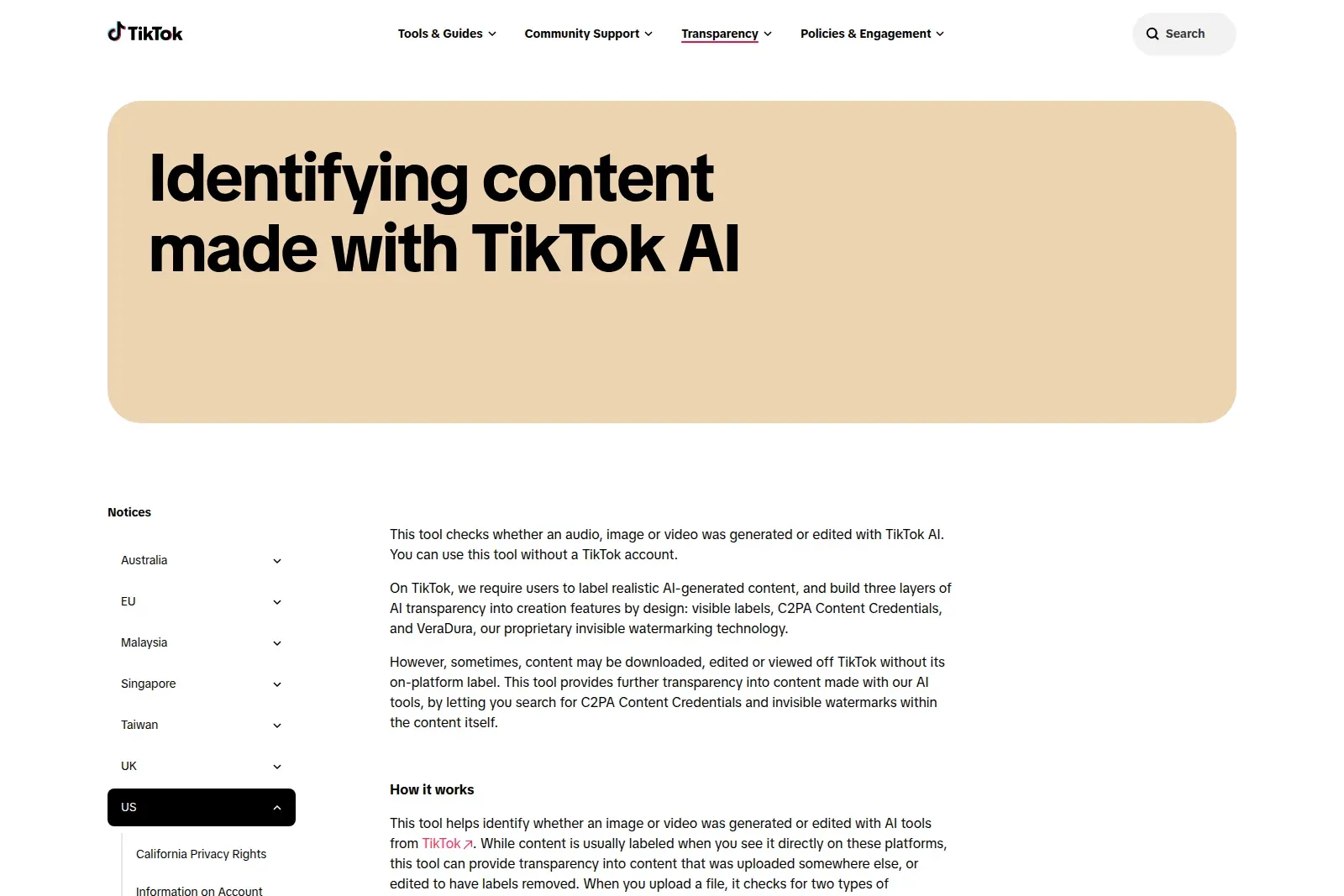
The second tool sits in TikTok’s Transparency Centre. Its own page says it checks whether audio, an image or a video was generated or edited with TikTok AI, and that it can be used without an account. It looks for two signals: C2PA Content Credentials, a metadata standard that TikTok adopted in 2024, and VeraDura, TikTok’s proprietary invisible watermark, which the company says is more durable and harder to remove.
The page sets limits of 20 MB per image and 100 MB per video. TikTok says uploads are deleted right after the result is shown and are never used to train models. Results are offered for general information only, the page adds, and can contain errors.
The tool only recognises TikTok’s own signals. If none is found, the page explains, the file may have been made with another company’s AI tools or may not be AI-generated at all, and AI content made on TikTok can still slip through when the metadata was stripped or the watermark degraded. As the page puts it, “no AI detection tool is 100% foolproof.”
Why it matters
The two tools answer different questions about synthetic people. Likeness Detection asks whether a face that looks like a real person was used without that person’s say. The checker asks whether a file came out of a particular set of AI tools. Neither one tells a viewer whether a person on screen is real.
TikTok says its systems have labelled more than 5 billion AI-generated videos to date. It also points out the weak spot of labels: Content Credentials can be lost as content is downloaded, reshared and edited. A watermark that TikTok says is harder to remove, and a checker that anyone can use, move part of the work of judging what is real from the platform to the viewer.
Sources
- TikTok Newsroom: More tools to provide clarity and control around AI-generated content, 24 November 2026
- TikTok Newsroom: Updates from the 2026 TikTok Safety and Innovation Forum, 23 November 2026
- TikTok: Identifying content made with TikTok AI, accessed 27 November 2026
This post was written with AI. Every claim was checked against the linked sources. About our AI use.

Every post on uncanny.news is written with AI. Each claim is checked against its primary source, which is linked in the post.